

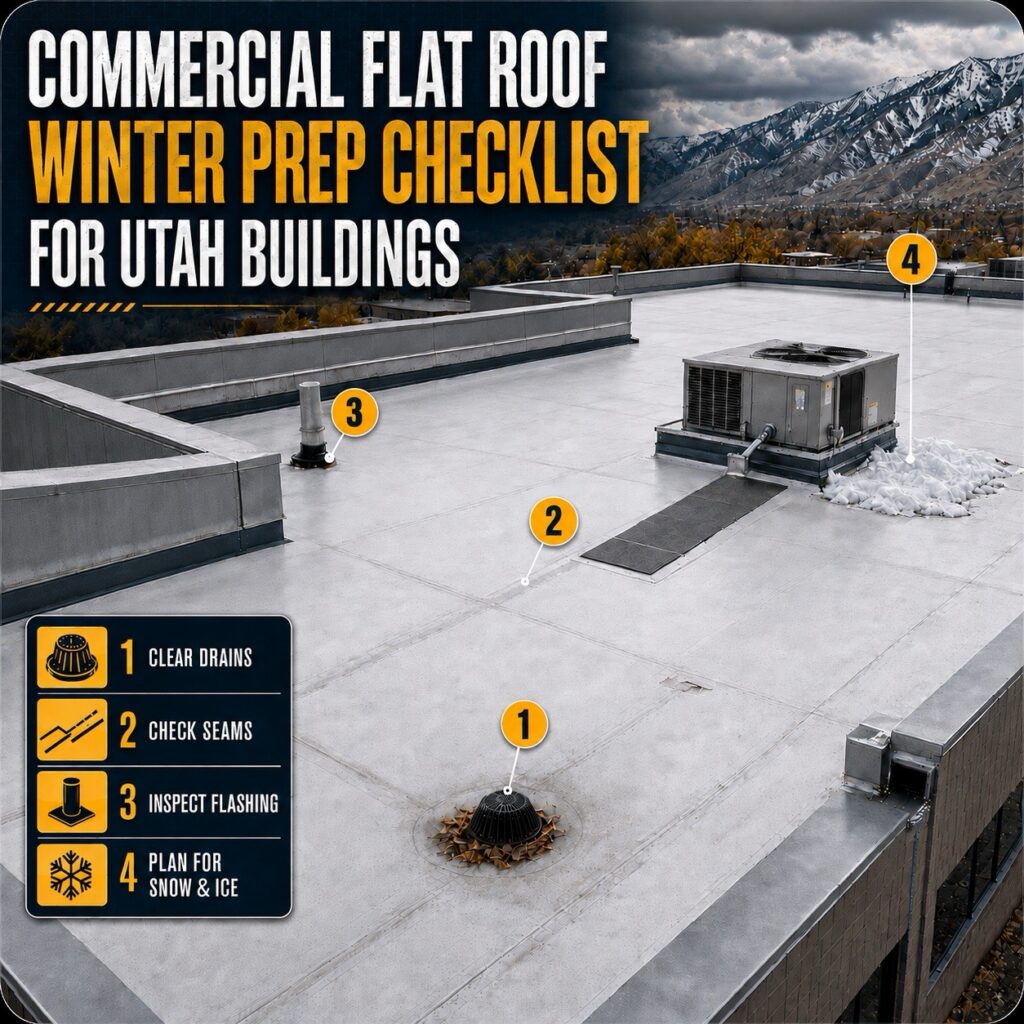
Quick answer: Before Utah winter, a commercial flat or low-slope roof should be inspected for blocked drainage, membrane damage, open seams, flashing concerns, vulnerable penetrations, loose rooftop items, and signs of recurring ponding. Property managers should also update roof records and decide who responds if a leak or heavy snow concern develops.
The best time to plan is before a freeze turns a slow drain into an ice problem or a small seam concern becomes an occupied-space leak. A documented fall inspection gives owners time to prioritize repairs and coordinate around tenants, deliveries, and operating hours.
Key Takeaways
Drainage paths, including drains, scuppers, gutters, and downspouts, should be clear and functional.
Membrane, seams, flashing, penetrations, and equipment curbs need a condition review.
Do not store loose materials on the roof or allow untracked trades to make penetrations.
Snow and ice removal decisions should be made by qualified professionals using the building’s structural information.
1. Is the Roof Drainage System Ready?
Low-slope roofs depend on drains, scuppers, gutters, and downspouts to move water off the building. Remove debris through a qualified maintenance process and confirm that strainers and outlets are secure. Look for sediment lines, staining, vegetation, or repeated ponding patterns that suggest slow drainage.
Water that remains after ordinary weather may point to blocked drainage, settled insulation, deck deflection, or slope conditions. The cause matters because simply clearing one drain will not correct every ponding area. During winter, blocked drainage can allow meltwater to refreeze and add load or push water toward weak details.
2. What Membrane and Seam Conditions Matter?
Check the field of the roof for punctures, cuts, blisters, open laps, displaced materials, and signs of foot-traffic damage. On TPO and other single-ply systems, seams and patches should be evaluated by someone familiar with the membrane. On metal systems, panel attachment, seams, fasteners, and edge details require their own inspection method.
Temporary repairs and old patches deserve special attention. A patch that stopped one leak may be approaching the end of its useful service. Document each area by location so future inspections can compare whether it is stable or changing.
3. Are Flashing and Penetrations Watertight?
Roof edges, parapets, walls, curbs, pipes, drains, and other penetrations are common places for movement and water entry. Look for split flashing, open terminations, loose metal, failed sealant at designed sealant joints, and damage around rooftop equipment.
Do not assume a bead of sealant is a complete repair. Commercial roof details often rely on multiple layers and compatible materials. The repair must fit the roof system and preserve drainage. All Star Roofing’s commercial roofing services cover inspections, repairs, replacements, flat roofing systems, TPO, metal roofing, and maintenance.
4. Has Rooftop Equipment Work Affected the Roof?
HVAC, electrical, solar, sign, and communications work can introduce new foot traffic or penetrations. Confirm that recent work did not leave screws, sharp debris, discarded filters, open panels, or damaged walkway pads. Verify that condensate and other discharge are directed as designed rather than onto vulnerable roof areas.
Keep a roof-access log and require outside trades to report any new penetration or observed damage. A roofer should review roof-system changes so that compatible flashing and repair methods are used.
5. Is the Building Ready for Snow and Ice Decisions?
Snow can drift around parapets, taller walls, rooftop units, and changes in roof elevation. Owners should know where building plans and structural information are kept and who has authority to call an engineer or qualified snow-removal contractor. Do not set a generic depth threshold without considering snow density, drifting, rain-on-snow, and the building’s design.
Warning signs such as unusual structural movement, ceiling changes, popping sounds, doors that suddenly bind, or severe drifting require immediate professional evaluation and may require evacuation. Roof snow removal should be planned and performed by qualified teams that protect both workers and the membrane.
6. Are Leak Response Materials and Contacts Current?
Update the roof plan, drain locations, warranty documents, repair history, contractor contacts, and tenant notification procedure. Identify sensitive interior areas such as electrical rooms, inventory, servers, medical spaces, or finished tenant areas. Make sure after-hours contacts know who can authorize emergency work.
If a storm causes damage, photographs and condition records can help establish what changed. All Star Roofing provides storm inspections and roofing documentation; coverage decisions remain with the insurance carrier.
Which Repairs Should Be Prioritized Before Winter?
Active leaks, open seams, punctures, loose edge metal, exposed substrate, damaged flashing, blocked primary drainage, and known overflow problems should be addressed first. Repeated ponding, deteriorated patches, and vulnerable equipment curbs should also move quickly through review.
Other items may be suitable for monitoring or planned capital work. A condition report should separate immediate repairs, near-term maintenance, and longer-range replacement planning so the owner can budget and schedule responsibly.
Frequently Asked Questions
How often should a commercial roof be inspected?
Many owners schedule spring and fall reviews, plus checks after severe weather and after other trades work on the roof.
Is ponding water always an emergency?
Not every residual area has the same significance, but recurring or deep ponding should be documented and evaluated against the roof design and manufacturer requirements.
Can maintenance be done while the building is occupied?
Often, yes. Access, odors, noise, parking, deliveries, and tenant communication should be coordinated before work begins.
Who should remove snow from a commercial roof?
Use qualified professionals who understand fall protection, structural risk, and how to avoid damaging the roof system.
What should a commercial roof report include?
Useful reports identify roof areas, observed conditions, photographs, urgency, recommended actions, and limits of the inspection.
Schedule the Fall Review Before Winter Disrupts Operations
Review All Star Roofing’s service coverage, then request a commercial roof inspection or call (801) 381-0727.