

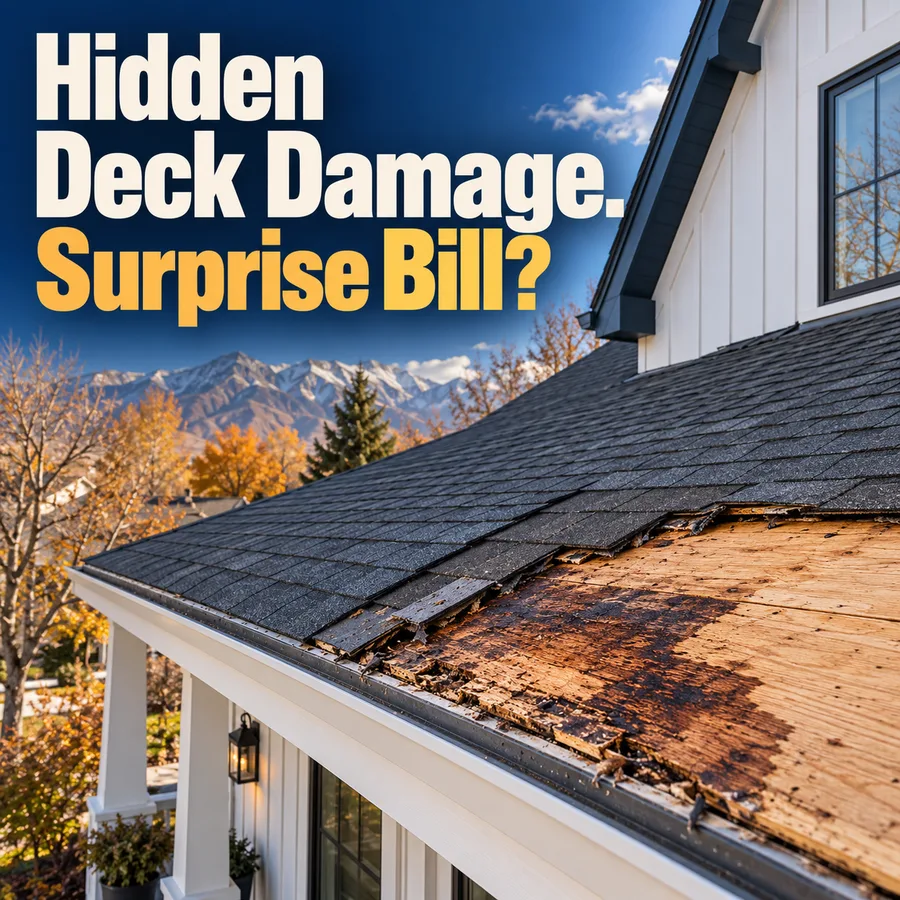
Quick answer: A decking allowance or unit price creates a pre-agreed method for handling damaged sheathing discovered after tear-off. It does not mean deck replacement is certain; it means the contract explains how necessary added work will be documented, measured, priced, and approved.
This question is best answered by connecting the visible condition to the surrounding roof system, the building history, and Northern Utah weather. Use roof replacement options to understand the relevant service context, then base the final decision on an on-site inspection and a written scope.
Key Takeaways
- Much of the deck is concealed until the old roof is removed.
- A unit price is clearer than an unlimited allowance or verbal promise.
- Photos and measured quantities should support any added charge.
- Structural framing problems fall outside ordinary sheathing replacement and may require design guidance.
Why Can the Deck Not Always Be Priced Up Front?
Attic access, visible eaves, and surface feel can reveal clues, but underlayment and covering hide much of the sheathing. Leaks may damage only small areas, while older additions or prior repairs can introduce unexpected materials or thicknesses.
A contractor should inspect what is reasonably accessible before bidding, but should not pretend that concealed square footage is known precisely.
What Should the Allowance Say?
The contract should define the unit being priced, such as a sheet or square foot, and what the price includes: removal, material, fastening, labor, disposal, and related work. It should state how partial sheets, thickness changes, or code and structural issues are handled.
The owner should know who can approve additional work and how the crew proceeds when waiting would leave the building exposed. A capped authorization or real-time photo process can reduce delay.
What Documentation Should the Owner Receive?
Useful records include before-and-after photographs, marked locations, quantities, the approved change order, and the final invoice. The replacement material should be suitable for the roof system and support conditions.
If rafters, trusses, widespread decay, or unusual movement are found, the roofing crew should stop and involve the appropriately qualified structural or building professional rather than treating framing as ordinary deck patching.
What Should You Do Next?
- Review all accessible deck clues during the preconstruction inspection.
- Confirm unit price, included work, measurement method, and approval authority.
- Agree on photo documentation and a rapid decision process during tear-off.
- Keep the final quantities and change orders with warranty and project records.
For a condition-specific recommendation, review free roof inspection. Keep photographs, dates, estimates, product information, and repair records together so later decisions use the same facts.
What Should a Professional Review?
- Visible and accessible deck condition
- Expected deck type and thickness
- Unit pricing and included labor
- Approval and documentation process
- Threshold for structural evaluation
A useful inspection separates the likely entry point or defect from contributing conditions. It should also identify when structural, electrical, mechanical, masonry, energy, design, or insurance questions belong with another qualified professional.
What Should You Avoid?
Avoid a contract that leaves concealed deck work completely unpriced or authorizes unlimited replacement without measurement and documentation.
Ground-level photographs and safely accessible interior observations are useful. Leave roof access, destructive testing, temporary coverings, and repairs to trained personnel, especially when surfaces are wet, icy, steep, or storm-damaged.
Frequently Asked Questions
Does every replacement require new decking?
No. Suitable deck areas may remain; replacement depends on actual condition and system requirements.
Is an allowance the same as a fixed charge?
Not necessarily. A unit-price provision charges for documented quantities actually replaced, while an allowance may be reconciled differently.
Can deck damage be seen from the attic?
Some areas can, but insulation, finishes, access, and the roof covering can hide conditions.
Who decides whether sheathing is unsuitable?
The contractor applies project and product requirements; unusual structural questions may need a qualified design professional or inspector.
Should deck replacement be photographed?
Yes. Labeled photos and quantities create a clearer record for both parties.
Get a Clear Roof Recommendation
The right answer depends on the actual roof, not one symptom viewed in isolation. Explore Utah roofing resources, or call All Star Roofing at (801) 381-0727 to schedule a free inspection or estimate. All Star Roofing is a family-owned, licensed and insured roofing company based in Orem with 30+ years of roofing experience. Insurance coverage decisions remain with the carrier, and project timing depends on weather, scope, materials, and scheduling.