

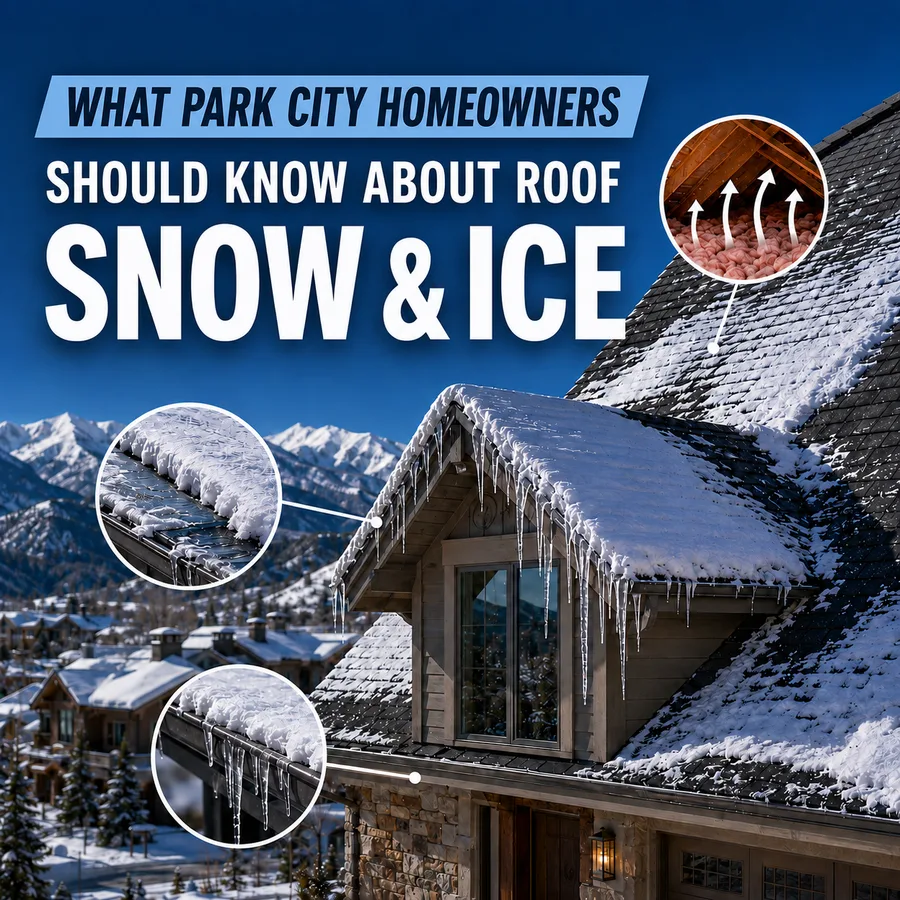
Quick answer: Park City roof planning should address snow accumulation, drifting, ice dams, safe shedding, ventilation, and winter access. The right response depends on the specific building and site, not a generic snowfall number.
The decision should begin with the building and site, not a generic rule. Compare observed conditions with a complete written scope and review the company’s Utah roofing resources information.
Key takeaways
- Park City roof planning should address snow accumulation, drifting, ice dams, safe shedding, ventilation, and winter access. The right response depends on the specific building and site, not a generic snowfall number.
- High-elevation sun can warm exposed roof areas even during cold weather, while shaded edges remain frozen. That contrast can drive repeated melt-refreeze cycles.
- Best next step: Use qualified help for roof access, snow load, or structural concerns.
What factors matter most?
Roof geometry
Valleys, dormers, step-downs, and parapets can concentrate drifting and meltwater. Evaluate it with the surrounding assembly because water and movement rarely stop at one component.
Indoor heat loss
Warm air leakage can create uneven snowmelt and cold-edge refreezing. Its importance depends on location, adjacent details, exposure, and the condition of the rest of the roof.
Pedestrian zones
Entrances, sidewalks, decks, and parking below eaves need snow-shedding review. A useful scope states how this detail connects to drainage, attachment, flashing, or maintenance.
Drainage
Gutters, scuppers, and lower roof areas can freeze or receive concentrated runoff. Look for evidence on this roof rather than assuming the same condition exists across every slope or area.
Observation
Uneven melt patterns, recurring icicles, and interior stains provide useful clues. Product instructions and the actual substrate help determine the appropriate response.
How do Utah conditions change the answer?
High-elevation sun can warm exposed roof areas even during cold weather, while shaded edges remain frozen. That contrast can drive repeated melt-refreeze cycles.
Conditions can change across short distances in Utah. Orientation, elevation, shade, terrain, and building use may change which detail deserves the most attention. Use product-specific requirements and local observations rather than a single statewide lifespan or performance promise.
What should you do next?
- Photograph recurring ice or uneven melt from the ground. Write the result down so later estimates and inspections can use the same facts.
- Have attic air leakage, insulation, and ventilation evaluated. The goal is to compare a complete scope instead of relying on a product name or a quick visual guess.
- Keep people away from active snow-shed zones. Where safety, structure, code, or electrical work is involved, use the appropriately qualified professional.
- Use qualified help for roof access, snow load, or structural concerns. Keep photos, product data, and written recommendations with the property records.
For a property-specific next step, review free roof inspection. The next step should explain observed conditions, separate urgent work from maintenance, and result in a clear written recommendation.
What should a professional review?
- Site elevation and exposure
- Roof geometry and drainage
- Snow, wind, sun, and temperature patterns
- Covering, underlayment, and flashing
- Attic or building-enclosure conditions
A useful inspection connects exterior evidence with interior symptoms and the building’s history. It should also identify when another qualified professional is needed for structural, electrical, mechanical, design, policy, or legal questions.
What should you avoid?
Avoid chipping ice with tools that can damage the roof or climbing onto a snow-covered surface.
Keep roof access out of the homeowner or tenant checklist. Steep, wet, icy, storm-damaged, and unfamiliar surfaces require trained people and appropriate safety procedures.
Frequently asked questions
Are icicles proof of an ice dam?
Not always, but repeated large icicles can signal meltwater and freezing conditions worth investigating.
Can gutters cause ice dams?
Blocked or frozen gutters can worsen drainage, though heat loss and roof temperature are often central factors.
Should all roof snow be removed?
No universal rule applies; building condition, load, weather, and safe methods matter.
Does more ventilation always fix the problem?
Ventilation must work with air sealing and insulation; adding vents without diagnosis may not solve it.
When should I call for help?
Call for leaks, recurring ice, unsafe shedding, damaged components, or signs of structural distress.
Get a clear roof recommendation
The right answer depends on the actual roof, not only its age or material. Learn about roof repair services, or call All Star Roofing at (801) 381-0727 to schedule a free inspection or estimate. Coverage decisions remain with the insurance carrier, and project timing depends on weather, scope, materials, and scheduling.