

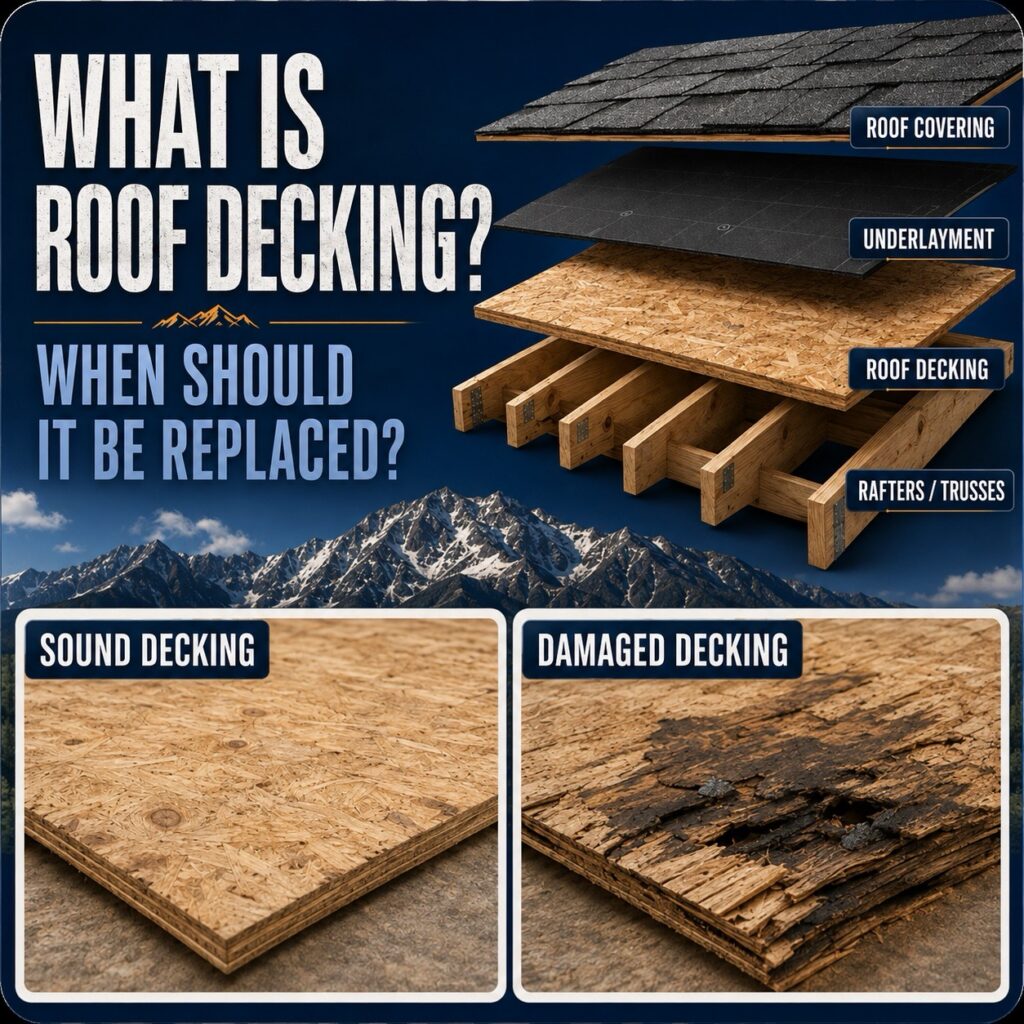
Quick answer: Roof decking, also called sheathing, is the solid surface attached to the roof framing beneath the underlayment and roof covering. Damaged sections may need replacement when they are soft, rotted, delaminated, broken, structurally inadequate, or unable to hold fasteners as required. The full extent is often confirmed only after tear-off.
Decking is hidden during normal use, so homeowners may first hear about it in a roofing estimate. A clear proposal should explain how the contractor will inspect the deck, document damage, price additional work, and obtain approval before replacing unexpected areas.
Key Takeaways
Decking connects the roof covering to the rafters or trusses and provides a continuous base.
Leaks, condensation, poor drainage, and long-term exposure can weaken it.
Not every stain requires replacement; condition and fastening capacity matter.
Some damage is visible from the attic, while other damage appears only after the old roof is removed.
What Does Roof Decking Do?
The deck spans across the roof framing and supports the underlayment, flashing interfaces, and roof covering. Common residential materials include plywood and oriented strand board, although older homes may have plank decking or other assemblies.
The correct deck must match the roofing system and applicable requirements. Panel thickness, spacing, support, fastening, and surface condition all affect performance. A sound deck gives shingles, panels, and accessories a stable base. It also helps distribute loads into the framing below.
What Causes Roof Deck Damage?
Repeated water entry is a common cause. Leaks around flashing, valleys, penetrations, or damaged roofing can wet the deck. Attic condensation can also affect the underside when indoor moisture reaches cold surfaces. Over time, wetting and drying may lead to swelling, delamination, rot, or loss of fastener holding strength.
Other causes include improper panel spacing, inadequate support, impact, previous construction damage, and long-term roof leakage that was hidden by insulation or finishes. Structural framing problems can create an uneven surface that should not be treated as a decking-only issue.
What Are Signs of Damaged Decking?
A newly sagging or uneven roofline
Soft areas identified by a roofing professional
Persistent leaks or stains in the same location
Dark, swollen, flaking, or visibly deteriorated sheathing in the attic
Fasteners that no longer hold properly
Daylight through breaks or gaps that are not part of the design
Sections exposed after wind or storm damage
These signs need professional evaluation. Do not walk on a roof suspected of having soft decking; the surface may not support weight safely.
Does All Decking Need to Be Replaced During a New Roof?
No. Sound, compatible decking may remain in place. Localized damaged panels or boards can often be replaced selectively when the surrounding deck and framing are suitable. More extensive replacement may be needed when deterioration is widespread, the existing deck does not provide an adequate fastening base, or the selected roof system requires a different substrate.
The decision should follow actual observations, the roofing system’s requirements, and any structural advice needed. Replacing every panel without a reason adds cost; covering damaged decking creates performance and safety concerns.
Why Is Damage Sometimes Found After Tear-Off?
Underlayment and the old roof covering hide the top surface. An attic view may show stains but not the full extent of deterioration, especially where insulation or limited access blocks the underside. Tear-off reveals the deck and allows the crew to test questionable areas before new materials are installed.
This is a normal reason for a defined decking allowance or unit price in a roof replacement proposal. The contractor should photograph the damage, explain why replacement is recommended, and follow the agreed change-order process.
How Should Decking Be Addressed in a Roofing Estimate?
Ask the proposal to state:
Whether tear-off and deck inspection are included
What known decking work is included
How additional panels or boards will be measured and priced
Who approves changes and how they are documented
Whether framing repairs, if discovered, require separate evaluation
How the deck will be prepared for underlayment and the new covering
All Star Roofing can explain these details during a roof replacement inspection. An instant roof estimate is useful for early planning, but hidden deck conditions cannot be confirmed online.
Can Damaged Decking Be Repaired Without Replacing the Roof?
Sometimes a localized repair can access and replace a damaged section, but the feasibility depends on its location, roof covering condition, surrounding materials, and cause of damage. The repair must restore the water-shedding system as well as the deck.
If deterioration is widespread or the covering is already near replacement, a broader project may be more practical. The first step is diagnosis: stop the moisture source, determine the damage extent, and choose a repair that fits the surrounding roof.
Frequently Asked Questions
Is roof decking the same as roof framing?
No. Decking is the surface attached over rafters or trusses. The framing carries loads and gives the roof its structure and shape.
Can wet decking dry without replacement?
Some wet materials may dry if the source is corrected, but softness, rot, delamination, deformation, and fastening capacity must be evaluated.
Does a ceiling stain mean the decking is rotten?
Not necessarily. A stain confirms moisture history, not the deck’s current structural condition.
Can new shingles be installed over soft decking?
Soft or deteriorated areas should be addressed so the roofing system has a sound fastening base.
Why is decking listed as an extra cost?
The exact quantity of hidden damage may not be known until tear-off. A clear unit price and approval process make that uncertainty manageable.
Find Out What Is Under the Surface
Explore more Utah roofing resources, then schedule an inspection or call All Star Roofing at (801) 381-0727.