

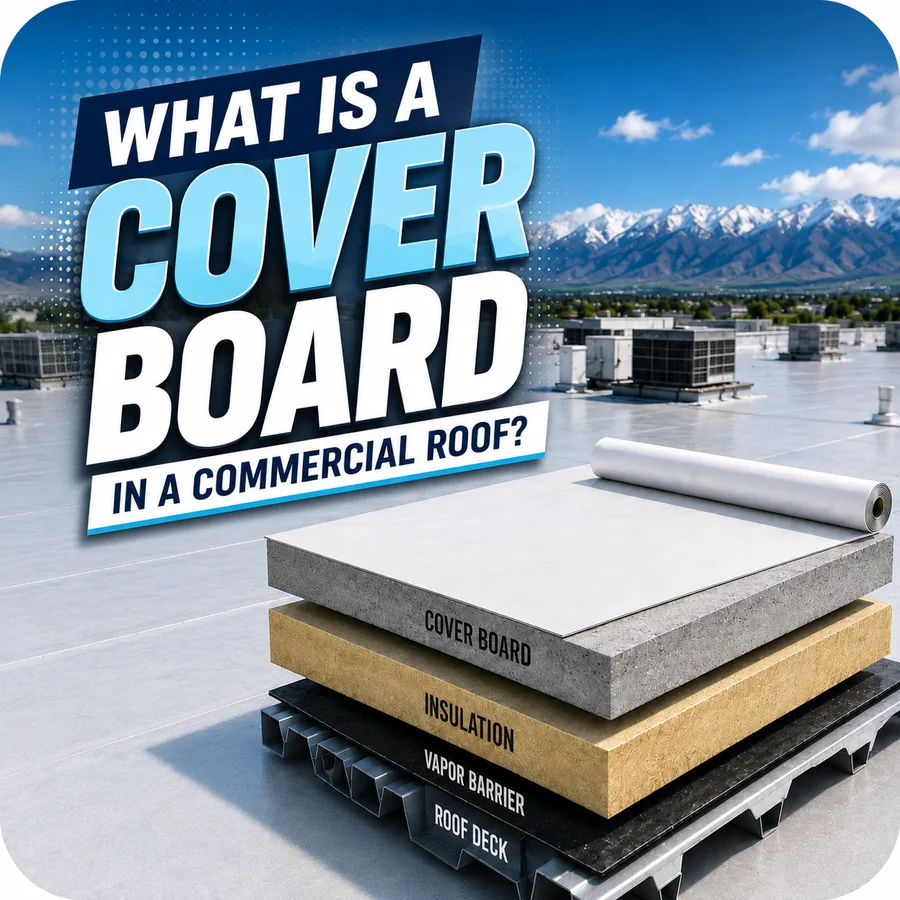
Quick answer: A cover board is a rigid layer placed between insulation and the roof membrane in many low-slope assemblies. Depending on the product and design, it can improve surface stability, impact resistance, fire performance, and support for membrane attachment.
Good decisions separate visible symptoms from the underlying cause. The company’s commercial roofing services page explains the related service context before an on-site recommendation.
Key takeaways
- A cover board is a rigid layer placed between insulation and the roof membrane in many low-slope assemblies. Depending on the product and design, it can improve surface stability, impact resistance, fire performance, and support for membrane attachment.
- Where Utah hail, service traffic, or rooftop equipment creates risk, cover-board selection can be part of a more resilient assembly discussion.
- Best next step: Document attachment and moisture conditions during installation.
What factors matter most?
Material
Gypsum-based, high-density polyiso, cementitious, and other products have different properties. Look for evidence on this roof rather than assuming the same condition exists across every slope or area.
Impact resistance
A stronger surface can reduce damage from traffic, hail, or dropped objects, but does not make the roof puncture-proof. Product instructions and the actual substrate help determine the appropriate response.
Attachment
Fastened, adhered, or other attachment methods must match the assembly design. Evaluate it with the surrounding assembly because water and movement rarely stop at one component.
Moisture
A cover board is not a remedy for wet insulation or an active leak. Its importance depends on location, adjacent details, exposure, and the condition of the rest of the roof.
Details
Thickness and transitions affect curbs, drains, edge heights, and flashing geometry. A useful scope states how this detail connects to drainage, attachment, flashing, or maintenance.
How do Utah conditions change the answer?
Where Utah hail, service traffic, or rooftop equipment creates risk, cover-board selection can be part of a more resilient assembly discussion.
Utah’s seasons test roof components in different ways. Dry-weather, winter, and post-storm observations may each reveal a different part of the problem. Use product-specific requirements and local observations rather than a single statewide lifespan or performance promise.
What should you do next?
- Identify the risks the board is meant to address. Write the result down so later estimates and inspections can use the same facts.
- Compare product properties and system approvals. The goal is to compare a complete scope instead of relying on a product name or a quick visual guess.
- Coordinate thickness with drainage and flashing heights. Where safety, structure, code, or electrical work is involved, use the appropriately qualified professional.
- Document attachment and moisture conditions during installation. Keep photos, product data, and written recommendations with the property records.
When the visible evidence is unclear, start with TPO roofing. The next step should explain observed conditions, separate urgent work from maintenance, and result in a clear written recommendation.
What should a professional review?
- Membrane or panel field
- Seams, flashings, curbs, and penetrations
- Drainage and recurring ponding
- Insulation or deck moisture indicators
- Access history, repairs, and rooftop equipment
A useful inspection connects exterior evidence with interior symptoms and the building’s history. It should also identify when another qualified professional is needed for structural, electrical, mechanical, design, policy, or legal questions.
What should you avoid?
Avoid selecting a board by thickness alone or claiming it eliminates hail and puncture damage.
Safety limits the do-it-yourself portion of this work. Avoid walking on a damaged or slippery roof and keep people clear of active snow- or debris-shedding areas.
Frequently asked questions
Is cover board the same as insulation?
No. Some products have limited thermal value, but the primary role is usually as a durable substrate layer.
Does every commercial roof need one?
No. Need depends on system design, risk, substrate, and project requirements.
Can it go over wet insulation?
Wet materials should be evaluated and addressed rather than concealed.
Does it make repairs harder?
It changes the assembly, but a documented system can still be inspected and repaired.
Is it useful under TPO?
It is common in some TPO assemblies; the exact product and attachment must be compatible and approved.
Get a clear roof recommendation
The right answer depends on the actual roof, not only its age or material. Learn about commercial roof replacement, or call All Star Roofing at (801) 381-0727 to schedule a free inspection or estimate. Coverage decisions remain with the insurance carrier, and project timing depends on weather, scope, materials, and scheduling.