

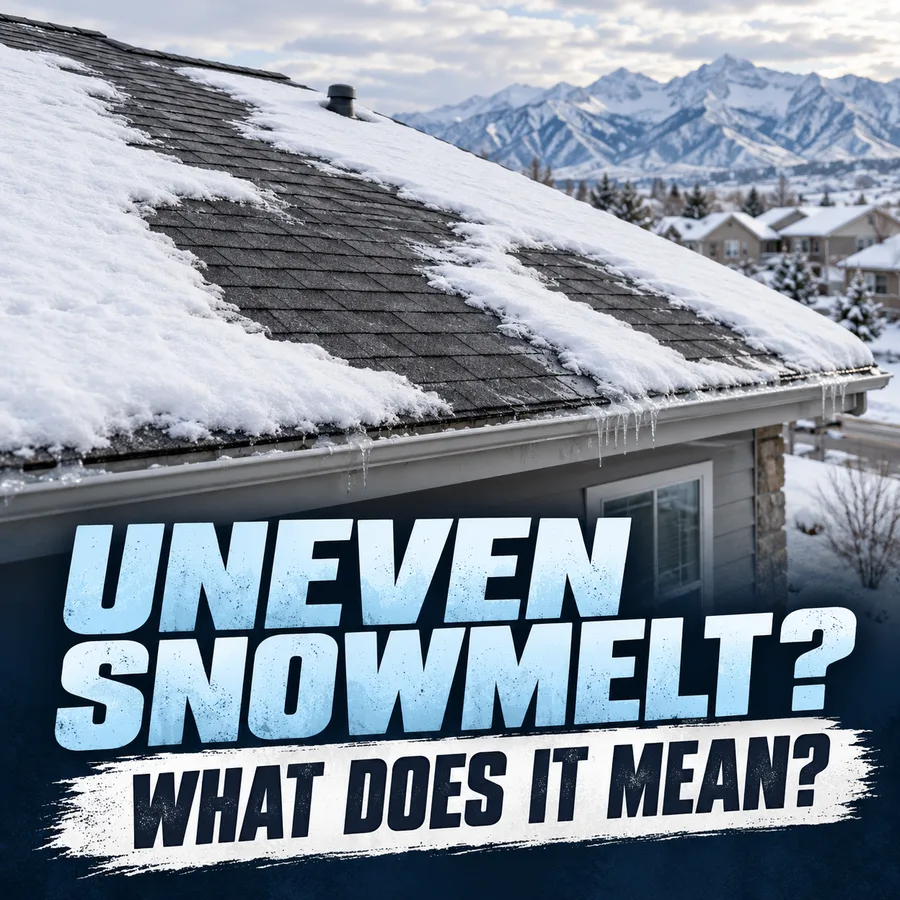
Quick answer: Uneven snowmelt can reflect ordinary sun and wind exposure, but it can also point to heat escaping into an attic, uneven insulation, blocked airflow, warm ducts, or differences in roof geometry. The pattern is useful evidence; it does not diagnose a roofing or insulation defect by itself.
Fresh snow can briefly make heat and airflow patterns visible. Similar slopes are the most useful comparison because south-facing and shaded surfaces naturally melt at different rates.
Homeowners should observe from the ground, take dated photos, and note indoor conditions. A roof, attic, insulation, or HVAC professional may be needed depending on what the pattern suggests.
Key Takeaways
- Compare slopes with similar orientation and shading.
- Look for repeated patterns, not a single patch after one storm.
- Pair exterior photos with attic moisture, frost, and insulation observations.
- Do not climb onto snow or use melting patterns to estimate structural capacity.
Which snowmelt patterns may be ordinary?
South- and west-facing slopes receive more sun, dark materials may warm differently, and wind can scour snow from exposed edges or ridges. Trees, neighboring buildings, chimneys, and roof intersections create shade and drifting that can make two parts of one roof look unrelated.
Heat from the sun can also warm a small metal vent or flashing detail and create a local bare area. These patterns are not automatically defects. The question is whether the same unusual pattern returns under similar weather and aligns with an indoor clue.
When can uneven melting point to heat loss?
Warm indoor air leaking through ceiling penetrations can raise the temperature of nearby attic surfaces. Thin or displaced insulation, an unsealed attic hatch, recessed fixtures, duct leakage, or mechanical equipment may create localized warm zones.
The U.S. Department of Energy notes that air sealing, insulation, and roof-deck ventilation work together in managing ice-dam risk. Adding a roof vent without finding the heat source may leave the real issue unchanged.
- Bare rectangles or stripes that repeat after storms
- Fast melting above an attic hatch or mechanical chase
- Ice forming below an otherwise bare upper slope
- Frost or dampness on nearby attic sheathing
How are snowmelt patterns connected to ice dams?
When snow melts over a warmer upper roof, and the water reaches a colder eave, it can refreeze. More meltwater may then collect behind that ice. Icicles or an icy edge can accompany this process, but the visible ice does not reveal the full cause.
Roof covering, underlayment, air leakage, insulation, ventilation, roof geometry, and weather all affect the outcome. The appropriate response may involve more than roofing work, so a coordinated evaluation is often more useful than treating the edge ice alone.
What should you document after a snowfall?
Photograph the roof from the same ground-level position once the storm ends and again during melting. Record the approximate temperature, sunshine, wind, indoor humidity concerns, and whether bathroom or kitchen exhausts were running.
Inside a safely accessible attic, look from a stable platform for frost, damp insulation, darkened sheathing, or disconnected exhaust ducts. Do not step between framing members or disturb suspected mold, wiring, or damaged materials.
Who should evaluate the pattern?
A roofer can review visible covering, flashing, penetrations, ventilation components, and moisture paths. An insulation or energy professional can evaluate the thermal and air-control layers. HVAC or electrical help may be appropriate when ducts, fans, wiring, or equipment are involved.
Start with the evidence rather than assuming one trade owns the entire problem. Clear photos and a written explanation help the professionals compare findings and recommend work in the right order.
Frequently Asked Questions
Does a bare patch always mean missing insulation?
No. Sun, wind, roof geometry, vents, and indoor heat sources can all change snowmelt. Repeated patterns and attic observations provide better context.
Should snow melt evenly on every roof slope?
No. Orientation, shade, wind, material, and slope affect melting. Compare similar areas under similar conditions.
Can uneven snowmelt cause a roof leak?
The pattern itself does not cause a leak, but heat-driven melting and refreezing may contribute to ice-dam conditions at vulnerable edges.
Can I check the attic myself?
Only from a safe, stable access point. Avoid exposed wiring, limited footing, low clearance, and any area with suspected structural or environmental hazards.
Will more roof vents fix the pattern?
Not necessarily. Ventilation should be evaluated with air sealing, insulation, exhaust ducts, and the actual roof design.
Get a Clear Roof Recommendation
For related service information and next steps, explore roof inspections, residential roofing services, roofing resources, and free roof inspection.
All Star Roofing is a family-owned, licensed, and insured roofing company based in Orem with 30+ years of roofing experience. Call (801) 381-0727 or schedule a free inspection for a practical recommendation based on the actual roof and current conditions.