

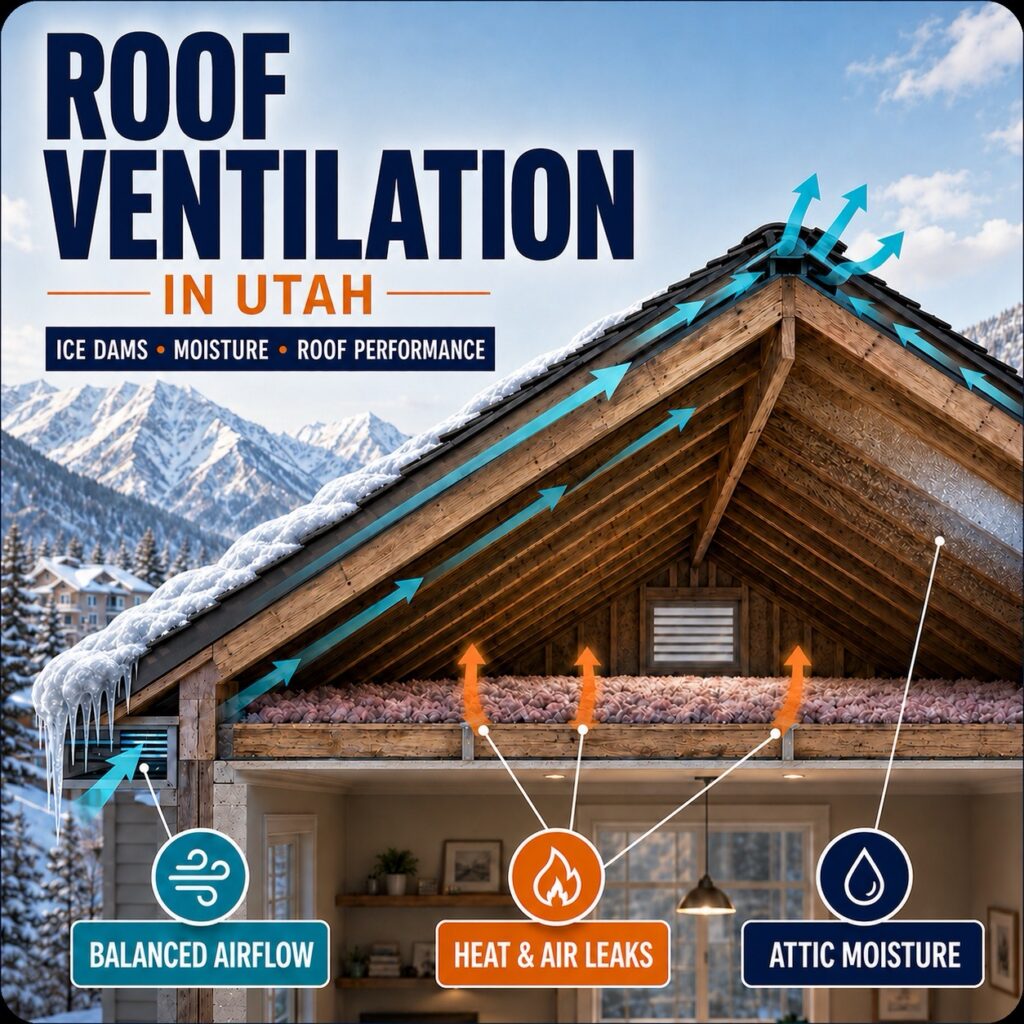
Quick answer: Roof ventilation allows outdoor air to move through a vented attic, usually entering low near the eaves and exiting higher on the roof. In Utah, that airflow can help manage attic heat and moisture, but it works best as part of a complete system that also includes air sealing, insulation, and properly installed roofing details.
Ventilation is important, but it is not a one-step cure for every hot attic, condensation problem, or ice dam. Blocked intake vents, bathroom exhaust terminating in the attic, air leaks from the home, uneven insulation, and roof design can all affect performance. A useful evaluation looks at the whole assembly rather than counting vents from the driveway.
Key Takeaways
Balanced intake and exhaust matter more than simply adding another roof vent.
Winter ice dam risk is closely connected to heat escaping into the attic and warming the roof deck.
Moisture, frost, musty odors, and uneven roof snow melt are clues, not complete diagnoses.
Ventilation changes should be designed around the roof, attic, insulation, and mechanical exhausts together.
How Does a Vented Attic Work?
In a typical vented attic, cooler outdoor air enters through intake openings near the soffits or eaves. Air then moves toward exhaust vents higher on the roof, such as ridge vents or other roof vents. The path should remain open so air can move beneath the roof deck.
Problems begin when intake is blocked by insulation, exhaust is insufficient or poorly placed, or parts of the attic have no practical airflow path. Mixing incompatible vent types can also create short-circuiting, where air enters and exits near the top without drawing from the lower attic. The correct approach depends on the roof shape and existing assembly.
How Does Ventilation Relate to Ice Dams?
Ice dams can form when snow on an upper, warmer portion of the roof melts and the water refreezes at a colder eave. Water may then collect behind the ice. Ventilation can help keep a vented roof deck closer to outdoor temperature, but it cannot compensate for major heat leakage from the living space.
Air sealing at the ceiling plane and adequate, properly placed insulation are often just as important. Recessed lights, attic hatches, duct leaks, and exhaust fans can move warm or moist indoor air into the attic. Because the causes can overlap, a roofer may need to coordinate findings with an insulation, energy, or HVAC professional.
If you see heavy icicles, repeated edge ice, or winter water staining, do not climb onto an icy roof. Document the pattern from a safe location and arrange a professional roof inspection.
Can Poor Ventilation Cause Attic Moisture?
Moisture can accumulate when humid indoor air reaches cold attic surfaces. That may lead to condensation or frost on fasteners and decking, damp insulation, staining, or musty odors. Ventilation can help remove moisture that reaches the attic, but the source of that moisture still matters.
Bathroom and kitchen exhausts should not discharge into the attic. Air leaks around penetrations can also carry moisture upward. A roof leak can create some of the same symptoms. That is why dark sheathing or wet insulation should be traced carefully before anyone assumes the solution is more vent openings.
What Are Signs the Roof and Attic Need Evaluation?
Uneven snow melt across similar roof slopes
Recurring ice buildup at eaves or in valleys
Frost, dampness, or dark staining on attic decking
Rusting fasteners or wet insulation
Musty attic odors or visible microbial growth
Bathroom or kitchen exhaust ducts ending in the attic
Blocked soffit vents or insulation packed against the roof deck
Interior stains that appear during snowmelt or large temperature swings
These signs do not prove one specific cause. They tell you the roof and attic should be assessed as a system. All Star Roofing’s residential roofing services include inspections that can identify visible roofing, flashing, and ventilation concerns.
What Should a Ventilation Evaluation Include?
A useful evaluation should identify intake and exhaust locations, check whether airflow paths are blocked, note the roof geometry, and look for moisture or heat patterns. It should also review visible roof penetrations, flashing, decking condition, and the way mechanical exhausts leave the home.
The recommendation may involve roofing work, baffles, air sealing, insulation changes, or correction of an exhaust duct. Sometimes the roof covering itself is performing normally while the attic needs attention. In other cases, leakage around a vent or flashing detail is the actual moisture source. Clear photographs and a written explanation help separate those paths.
Should Ventilation Be Reviewed During Roof Replacement?
Yes. Replacement creates an opportunity to review the intake and exhaust strategy, roof deck condition, underlayment, and penetrations before the new covering is installed. Ventilation should be planned for the actual assembly rather than copied automatically from a neighboring home.
If you are still at the planning stage, All Star Roofing’s instant roof estimate can provide a starting range, followed by an on-site inspection to confirm scope. Additional education is available in the Utah roofing resource center.
Frequently Asked Questions
Does every attic need the same amount of ventilation?
No. Requirements and practical design depend on the attic, roof shape, vent type, air barrier, insulation, and applicable building requirements.
Will adding a ridge vent stop ice dams?
Not necessarily. Ice dams can involve air leakage, insulation, blocked intake, roof geometry, and weather. Adding exhaust without adequate intake may not solve the problem.
Why is there frost on attic nails?
Frost can form when moist air contacts cold metal. The moisture source and airflow conditions should be investigated.
Can too many vents be a problem?
Poorly coordinated vent types can disrupt intended airflow. Ventilation should be designed as a balanced system.
Can a roofer evaluate attic ventilation?
A roofer can evaluate roofing and visible ventilation conditions. Some findings may also call for an insulation, energy, or HVAC specialist.
Get a Clearer Picture of Your Roof and Attic
All Star Roofing serves homeowners across Orem, Provo, Salt Lake City, Utah County, and nearby Northern Utah communities. Call (801) 381-0727 or schedule a free inspection for practical, no-pressure guidance.