
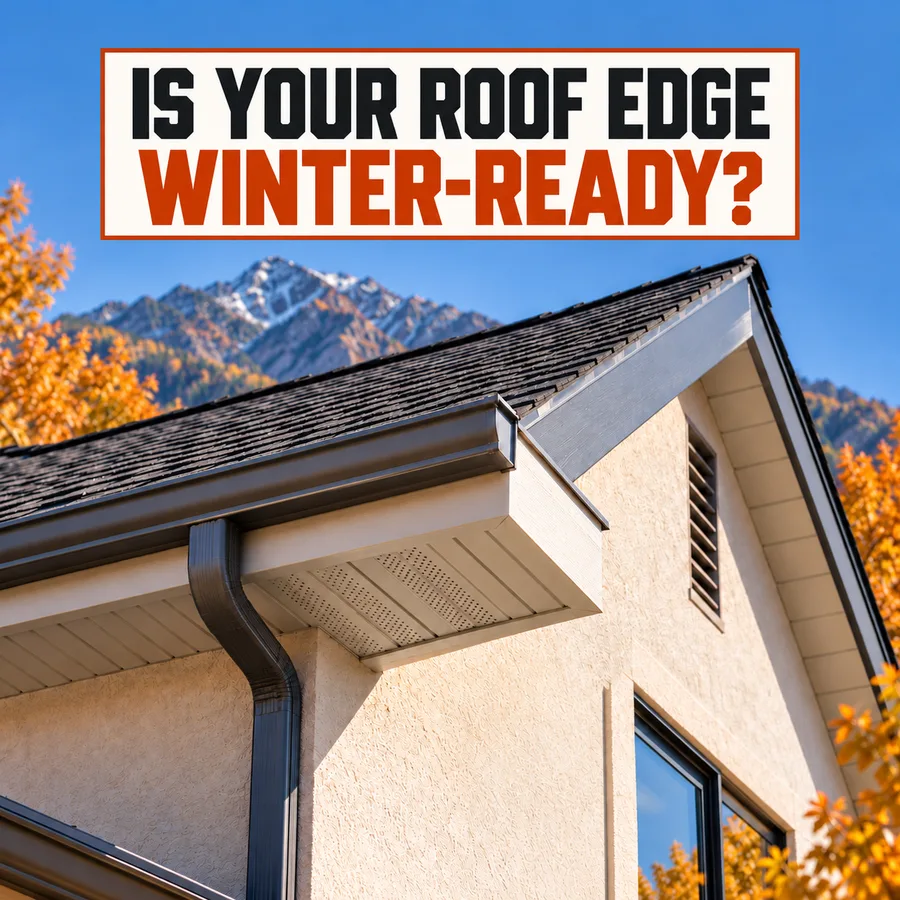
Quick answer: Eaves are the lower horizontal roof edges, rakes are the sloped edges at a gable, and soffits cover many roof overhangs from below. These areas help manage water, wind, ventilation, and the transition between the roof and walls, so damage at an edge can affect more than appearance.
Knowing the names helps homeowners describe a problem accurately when calling a roofer. It also helps explain why an icy lower edge, a wind-damaged gable, and a stained soffit may have different causes.
Roof edges are assemblies. Shingles or panels, drip edge, fascia, soffit, flashing, ventilation, gutters, and underlayment need to work together.
Key Takeaways
- The eave is where runoff normally leaves a sloped roof.
- The rake is a sloped gable edge that can be highly exposed to wind.
- The soffit is the underside of an overhang and may contain attic intake vents.
- Peeling paint or staining at one component does not identify the source by itself.
What is a roof eave?
The eave is the lower edge of a sloped roof, usually running horizontally along the wall. Water reaches this edge after moving down the roof, then passes into a gutter or falls clear of the building depending on the design.
Ice often becomes visible here because the overhang can be colder than the roof above the heated building. Eave performance involves edge metal, underlayment, fascia, gutters, ventilation intake, and the condition of the roof covering.
What is a roof rake?
The rake is the sloped edge that runs from an eave toward the ridge at a gable end. Because it faces sideways to the roof plane, it can experience wind pressure and wind-driven precipitation differently from the field of the roof.
Look from the ground for displaced edge shingles, loose trim, open metal flashing, lifted fascia, or gaps that appeared after strong wind. Do not press or nail materials back into place without understanding the edge assembly.
What does a soffit do?
A soffit finishes the underside of many overhangs. Perforated or vented soffit panels may provide intake air for a vented attic, while solid sections may be used where ventilation is provided another way.
Stains, sagging panels, pest openings, blocked vents, peeling finishes, or frost near the edge deserve attention. The cause may involve roof leakage, gutter overflow, attic moisture, or a disconnected panel.
- Keep intake openings free of insulation and debris when the assembly is designed for soffit ventilation.
- Do not paint, cover, or seal vent openings without evaluating the ventilation design.
Which winter problems show up at roof edges?
Ice dams, icicles, wind damage, gutter overflow, snow sliding, and wind-driven snow can all affect edges. Repeated wetting may also deteriorate fascia or soffit materials even when no stain reaches the living space.
A roofer should trace the water path from the covering through the edge and drainage components. An attic review may be appropriate when heat loss, frost, or blocked intake is suspected.
What should a roof-edge inspection include?
The inspection should review the visible covering, drip edge or trim, fascia attachment and condition, soffit panels and vents, gutter position, fasteners, and nearby flashing. On metal roofs, closure details and panel movement may also matter.
Ask for photographs that label the component and explain the finding. Clear terms make it easier to compare repair scopes and avoid paying for a cosmetic fix that does not address the water or airflow path.
Frequently Asked Questions
Is the fascia the same as the soffit?
No. Fascia is the face at the roof edge; soffit is generally the underside of the overhang.
Why is my soffit stained?
Possible causes include roof leakage, gutter overflow, condensation, or exterior wetting. The source should be traced before repairs are chosen.
Do all soffits need vents?
No. Ventilation design depends on the roof and attic assembly. Do not assume that every soffit panel should be perforated.
Why are rake edges vulnerable to wind?
Their exposed position can concentrate wind forces on edge materials and trim, especially where attachment or surrounding materials are weak.
Can roof-edge damage be repaired without replacing the roof?
Often, when damage is isolated and sound materials allow a durable tie-in. The inspection should determine the actual extent.
Get a Clear Roof Recommendation
For related service information and next steps, explore residential roofing services, roof repair, roof inspections, and free roof inspection.
All Star Roofing is a family-owned, licensed and insured roofing company based in Orem with 30+ years of roofing experience. Call (801) 381-0727 or schedule a free inspection for a practical recommendation based on the actual roof and current conditions.