

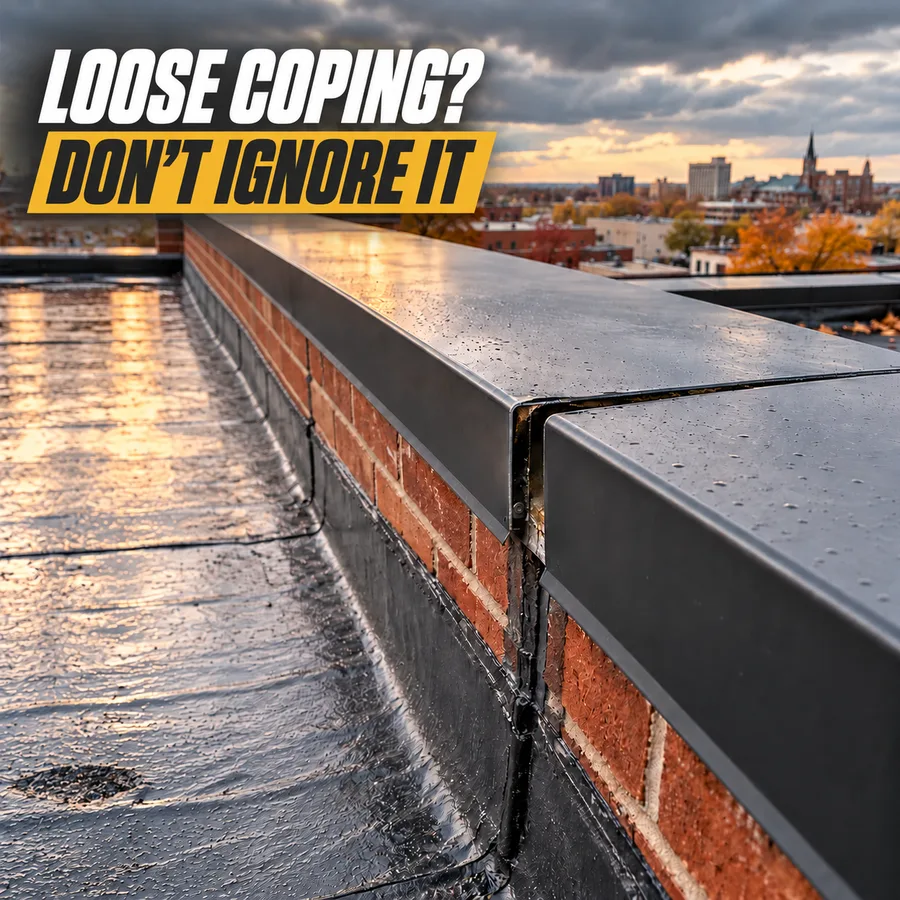
Quick answer: Parapet walls extend above many low-slope roofs, and coping protects their top edge. Before winter, inspect coping joints, attachment, sealant, wall surfaces, membrane terminations, and drainage because water can enter at the wall or top and appear far from the visible defect.
A parapet is both a wall and a roof-edge condition. Roofing, sheet metal, masonry, cladding, sealants, and structure may all meet in a narrow area.
Wind can stress coping and edge metal, while snow can drift against the wall and hold meltwater near base flashing. A useful inspection looks above, below, and along the wall.
Key Takeaways
- Check coping joints, corners, transitions, end conditions, and visible fasteners.
- Review base flashing and termination bars where the roof membrane turns up the wall.
- Distinguish wall or coping entry from membrane and drainage problems.
- Prioritize loose metal over entrances, sidewalks, and occupied areas.
What is the difference between a parapet and coping?
A parapet is the portion of a wall that extends above the roof. Coping is the cap at the top, often made of formed metal, masonry, stone, or another weather-resistant assembly that sheds water from the wall.
The roof membrane usually turns up the inside face and terminates at or below the wall top. The coping and membrane flashing must manage different water paths while accommodating movement.
Where do parapet leaks begin?
Water may enter through open coping joints, failed sealant, loose or poorly lapped metal, cracked masonry, open wall joints, failed base flashing, or roof penetrations near the wall. It can travel within the wall or roof assembly before appearing inside.
Staining high on an interior wall does not prove the coping is the source, and a wet ceiling near the parapet does not prove the field membrane is at fault. Both systems need review.
How do snow and wind affect the edge?
Parapets interrupt wind, so snow may drift on one side while exposed metal experiences uplift and thermal movement. Meltwater can remain against the base flashing or reach a joint from above.
Loose coping is also a falling-object hazard. A visibly displaced section, rattling metal, or open corner over a public area deserves prompt professional attention and a protected ground zone.
- Open or uneven coping joints
- Loose corners or end caps
- Cracked masonry or sealant
- Membrane pulling at termination
- Repeated staining below the wall
What should the fall inspection document?
Photograph each elevation and label corners, transitions, expansion joints, penetrations, scuppers, and prior repairs. Note whether sealant is cohesive and bonded, whether metal is secure, and whether the membrane flashing is wrinkled, split, or pulling away.
The report should assign responsibility by trade where possible. Sheet-metal, masonry, cladding, roofing, and structural work should not be combined into a vague instruction to reseal the wall.
How are parapet problems repaired?
The repair depends on the material and movement. It may involve replacing or re-securing coping, rebuilding a joint, repairing masonry, restoring membrane flashing, or correcting a transition. Compatible materials and proper laps are more durable than surface coating over an unknown path.
All Star Roofing can evaluate roof-side and metal conditions and coordinate recommendations when another specialty is needed. Ask for a scope that explains how the repaired layers will drain and move.
Frequently Asked Questions
Is coping only decorative?
No. Coping protects the parapet top and helps direct water away from the wall assembly.
Can failed coping cause a roof leak?
Yes, but wall, masonry, membrane, and drainage conditions can produce similar symptoms, so the path should be traced.
Should all coping joints be caulked?
Joint design varies. Sealant may be part of some systems, while internal splice plates or other details manage water and movement in others.
Why does coping move?
Metal expands and contracts with temperature, and wind can stress weak attachment. Joints and fastening must accommodate the system’s design movement.
Who repairs cracked parapet masonry?
Use a qualified masonry or building-envelope professional, coordinated with the roofer where the wall meets the roof.
Get a Clear Roof Recommendation
For related service information and next steps, explore commercial roof maintenance, commercial roof repair, commercial roofing services, and free roof inspection.
All Star Roofing is a family-owned, licensed and insured roofing company based in Orem with 30+ years of roofing experience. Call (801) 381-0727 or schedule a free inspection for a practical recommendation based on the actual roof and current conditions.