
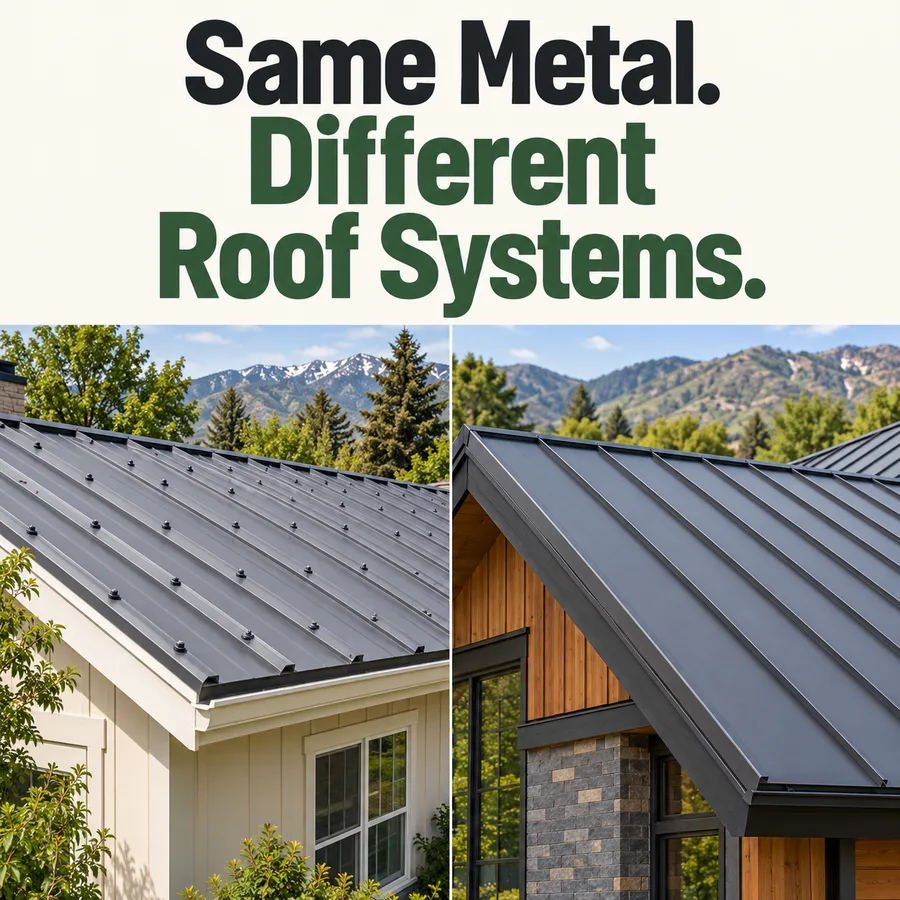
Quick answer: Exposed-fastener panels are secured through the panel face with visible fasteners and sealing washers, while standing-seam panels typically use raised seams and concealed clips or fasteners. Each system has different slope, substrate, detailing, thermal-movement, maintenance, appearance, and cost considerations.
This question is best answered by connecting the visible condition to the surrounding roof system, the building history, and Northern Utah weather. Use metal roofing options to understand the relevant service context, then base the final decision on an on-site inspection and a written scope.
Key Takeaways
- The label ‘metal roof’ does not describe one assembly or performance level.
- Exposed washers and fasteners require inspection and maintenance over time.
- Standing-seam details must accommodate panel movement and compatible penetrations.
- The right system depends on the building, roof geometry, use, budget, and manufacturer design.
How Are the Panels Attached?
Exposed-fastener panels are commonly fastened directly through the metal into the support below, leaving heads and washers visible. Correct fastener type, location, drive depth, alignment, and substrate engagement are critical.
Standing-seam panels connect at raised seams and often attach through concealed clips or flanges. The details can allow thermal movement while keeping most primary fasteners out of the exposed drainage surface.
How Do Maintenance Needs Differ?
Exposed-fastener systems should be checked for backed-out, tilted, overdriven, underdriven, damaged, or deteriorated fasteners and washers. Panel laps, closures, trim, sealants, and penetrations also need review.
Standing-seam systems still require maintenance at seams, clips, transitions, penetrations, snow-retention attachments, coatings, and perimeter details. Concealed fasteners do not make the roof maintenance-free.
Which System Fits the Project?
Consider roof slope, panel length, substrate, wind and snow design, building use, desired appearance, penetration count, future equipment, budget, and warranty requirements. Agricultural, residential, and commercial buildings can have very different needs.
Compare complete written assemblies rather than panel gauge or color alone. Underlayment, ventilation or enclosure design, flashing, attachment, trim, and workmanship often decide performance.
What Should You Do Next?
- Identify roof slope, deck or framing, panel lengths, penetrations, and expected movement.
- Compare attachment, flashing, underlayment, coating, trim, and maintenance details.
- Review snow shedding, pedestrian areas, and future rooftop attachments.
- Use the selected manufacturer’s tested details and project-specific design requirements.
For a condition-specific recommendation, review free roof inspection. Keep photographs, dates, estimates, product information, and repair records together so later decisions use the same facts.
What Should a Professional Review?
- Panel profile, slope, and substrate
- Fasteners, clips, seams, and thermal movement
- Underlayment and enclosure conditions
- Edges, penetrations, and transitions
- Coating, maintenance, snow, and warranty requirements
A useful inspection separates the likely entry point or defect from contributing conditions. It should also identify when structural, electrical, mechanical, masonry, energy, design, or insurance questions belong with another qualified professional.
What Should You Avoid?
Avoid choosing by appearance or price per panel alone, and do not assume every exposed-fastener or standing-seam product shares the same tested performance.
Ground-level photographs and safely accessible interior observations are useful. Leave roof access, destructive testing, temporary coverings, and repairs to trained personnel, especially when surfaces are wet, icy, steep, or storm-damaged.
Frequently Asked Questions
Are standing-seam fasteners completely hidden?
Primary attachments are commonly concealed, but some trim or detail fasteners may still be exposed depending on the system.
Is exposed-fastener metal only for sheds?
No. It is used on many building types, but the selected product and details must fit the project.
Which system costs more?
Standing-seam systems are often more complex, but actual cost depends on product, substrate, geometry, details, access, and market conditions.
Do both systems expand and contract?
Yes. Metal moves with temperature; each system must manage that movement through its design and attachment.
Which one is best for snow?
There is no universal answer. Slope, attachment, structure, underlayment, snow retention, and pedestrian safety all matter.
Get a Clear Roof Recommendation
The right answer depends on the actual roof, not one symptom viewed in isolation. Explore Utah roofing resources, or call All Star Roofing at (801) 381-0727 to schedule a free inspection or estimate. All Star Roofing is a family-owned, licensed and insured roofing company based in Orem with 30+ years of roofing experience. Insurance coverage decisions remain with the carrier, and project timing depends on weather, scope, materials, and scheduling.