

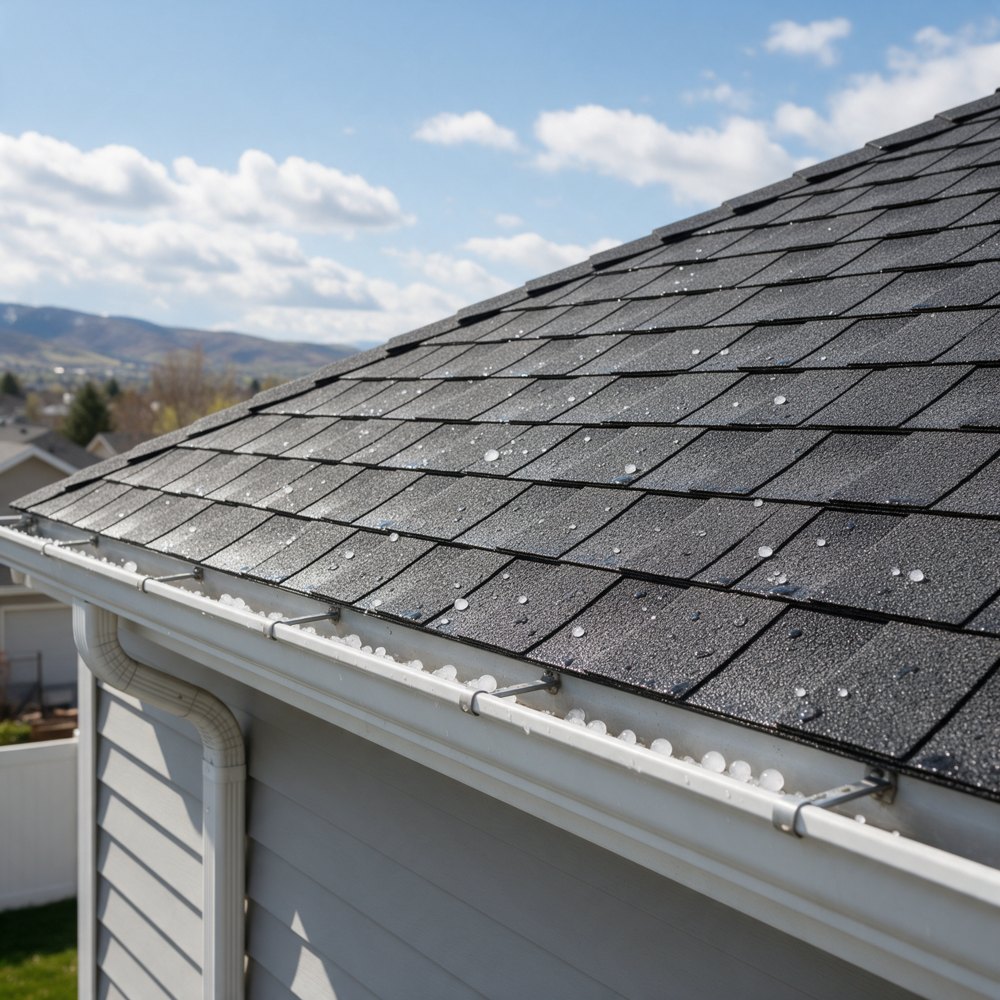
Class 4 is the highest impact-resistance classification in the UL 2218 test, but it is not a promise that a shingle will survive every Utah hailstorm. Class 3 and Class 4 shingles can both be worth considering when replacing a roof. The useful comparison is between specific products, the complete installation, the price difference, and any insurance benefit your carrier actually confirms.
That distinction matters along the Wasatch Front. A homeowner in Orem may be replacing an aging roof with no recent storm damage. A homeowner in South Jordan may be comparing an upgrade after a claim. They can arrive at different sensible choices even when both houses use architectural asphalt shingles. Buying the highest number on the brochure is only one part of the decision.
What Class 3 and Class 4 actually tell you
UL 2218 evaluates how prepared roofing samples respond to impacts from steel balls under controlled laboratory conditions. The classifications run from Class 1 through Class 4. Class 4 represents the most demanding impact level in that test. The result is useful evidence about a product, provided you are looking at the exact shingle named in the test documentation.
It does not recreate every combination of hail shape, ice hardness, wind, impact angle, roof age, temperature, or substrate. It also does not measure all the things homeowners mean by a “better roof.” Wind resistance, fire classification, algae resistance, appearance, fastening requirements, and warranty terms are separate questions.
The Insurance Institute for Business & Home Safety explains the limits of impact classifications. Its separate shingle research uses realistic hail impacts and evaluates damage beyond a single pass/fail label. That gives homeowners a second useful reference when shopping for an impact-resistant roof.
| Question | Class 3 | Class 4 |
|---|---|---|
| What does the class describe? | A tested impact-resistance level | The highest level in UL 2218 |
| Does it prove the roof is hailproof? | No | No |
| Does it establish wind or fire performance? | Those need separate documentation | Those need separate documentation |
| Will insurance automatically cost less? | Carrier and policy dependent | Carrier and policy dependent |
| What should you compare next? | Exact product, installation, price, warranty | Exact product, installation, price, warranty |
Why two Class 4 shingles may perform differently
Impact-resistant shingles are not all built the same way. Manufacturers can use different asphalt formulations, reinforcing layers, and construction methods. A shared classification does not mean two products have identical resistance to dents, cracking, granule loss, or other effects of an actual hail impact.
IBHS publishes product-specific hail performance ratings and expanded its ratings in November 2025. Check the current list for the exact shingle you are considering; products from the same manufacturer can receive different results.
When a roofer recommends an upgrade, ask for the exact manufacturer, product line, and supporting document. “Premium architectural shingle” is not enough detail to confirm a class. Neither is a sample that resembles another product. The proposal, ordered material, packaging, and warranty paperwork should all refer to the same product.
It is also worth asking what is available in your preferred color and when it can be delivered. A theoretically attractive option has limited value if it does not fit the roof, the budget, or the project schedule. A written comparison makes those tradeoffs easier to evaluate.
Is Class 4 worth it for a Utah home?
It may be, especially when the incremental cost is reasonable and you expect to own the home for a while. The strongest case usually comes from a combination of verified product performance, local exposure, an aging roof that already needs replacement, and a carrier-confirmed premium benefit. None of those factors should be guessed from the ZIP code alone.
Start with your property’s history. Have previous storms damaged this roof or neighboring roofs? Is the roof exposed without much shelter? Is the replacement part of a broader effort to improve the roof system? These are useful discussion points, not a way to predict the next hailstorm.
Then compare actual bids. If the base shingle and the impact-resistant option use the same appropriate underlayment, flashing scope, ventilation work, and decking assumptions, the upgrade price is easier to understand. If one proposal quietly removes important work to make the premium shingle look affordable, you are no longer comparing equivalent roofs.
A Class 3 option can still be a reasonable choice when it is a documented product, properly specified, and the Class 4 alternative would stretch the budget at the expense of necessary work. A sound roof system is more valuable than a higher classification paired with neglected flashing or deteriorated decking.
Separate the insurance question from the roofing question
Some insurers offer incentives for qualifying impact-resistant roofs. Availability, eligible products, documentation, discount size, and renewal treatment vary. Do not assume that Class 4 automatically qualifies or that a discount will continue for the full life of the roof.
Before choosing a shingle for an insurance benefit, ask your agent or carrier for written answers:
- Does this exact product qualify under my current policy?
- What installation certificate, invoice, photograph, or other documentation is required?
- How much would the annual premium change with all other coverage held constant?
- Are there roof-age conditions, cosmetic exclusions, or other endorsements I should review?
- Would my wind or hail deductible remain the same?
Use the confirmed annual savings to evaluate the upgrade, then allow for uncertainty. For example, dividing the additional shingle cost by a documented annual premium reduction gives a simple comparison period. It does not guarantee future savings because insurance terms and ownership plans can change. Do not count an unconfirmed discount as money already saved.
The Utah Insurance Department’s home-claims information is a useful starting point for understanding the insurance side. Your carrier decides coverage under your policy. All Star Roofing can document roof conditions and provide a roofing scope; selecting an impact-resistant product does not guarantee claim approval.
If an insurance estimate is part of your decision, our guide to reading the roofing scope in an insurance estimate explains how to separate the documented work from product-upgrade choices.
The roof underneath the shingles still matters
An impact rating does not make deteriorated sheathing sound. It does not seal a poorly built wall transition or correct an attic moisture problem. During a replacement, the contractor should evaluate the surfaces and details that support the new shingles, then explain how unexpected conditions will be handled.
Decking provides the base for the installation. If it is soft, damaged, or unsuitable for the specified fastening, that needs attention. Ask how decking replacement is priced, what observations trigger it, and how you will receive documentation before additional work proceeds.
Flashing deserves the same attention. Chimneys, sidewalls, valleys, pipe penetrations, and roof-to-wall intersections can leak even when the surrounding shingles remain intact. A bid should identify what will be replaced, what may be reused after inspection, and how the work will integrate with the water-shedding layers.
Underlayment, ventilation, starter strips, ridge components, and fastening also need to fit the manufacturer’s instructions and applicable requirements. These are not interchangeable accessories added after choosing the “main” product. They are part of the assembly you are purchasing.
All Star Roofing’s asphalt shingle roofing service and roof replacement information can help you start that discussion. The final scope should address your house rather than relying on a classification alone.
Read the warranty before interpreting the rating
Impact classification, manufacturer warranty, and workmanship coverage are different things. A shingle can have a high impact rating while its warranty excludes damage caused by hail. A long manufacturer warranty may address manufacturing defects without covering every labor expense, accessory, or consequence of a leak.
Ask for the actual warranty document rather than relying on “lifetime” or “premium” language. Look for the covered defect, exclusions, prorated periods, registration rules, transfer conditions, and any installation requirements. Enhanced coverage can have additional eligibility conditions; do not assume that choosing a brand automatically provides it.
All Star Roofing offers a 10-year labor warranty. Have the written project documents explain its terms and how it relates to the selected product’s manufacturer warranty. Do not interpret that labor warranty as a promise that every future storm event or unrelated roof problem is covered.
Keeping the invoice, product details, warranty documents, installation date, and maintenance records together makes later questions much easier to resolve. Those records are also useful if you sell the house or need to provide roof information to an insurer.
When an inspection should come before an upgrade discussion
If you are researching Class 4 shingles because of a recent storm, first determine what actually happened to the existing roof. Marks visible from the ground can have several causes. Granules in a gutter, a dark spot, or a dent in metal does not by itself establish a covered shingle loss or the need for a complete replacement.
A condition assessment should consider the roof’s age, repair history, slopes, accessories, and evidence of damage. The right response may be a targeted repair, documentation for an insurer, monitoring, or replacement. The shingle upgrade discussion becomes useful once you know what work is justified.
Use a roof inspection to get a condition-specific starting point. If there is active leaking, explain that when you call so the immediate problem can be evaluated alongside the longer-term decision. Leave roof access and close examination to trained professionals.
A practical way to compare your final two options
Ask for a side-by-side proposal with the base and upgraded shingle named explicitly. Keep the rest of the necessary work consistent. Then review four items: the additional installed price, the exact product’s available testing, the written warranties, and the insurer’s confirmed response.
Consider how long you expect to remain in the home, but avoid assigning an unsupported resale premium. Buyers may appreciate a well-documented roof, yet there is no automatic dollar return simply because the packaging says Class 4. The defensible value is the roof you receive and the documented benefits available to you.
You do not need to become a roofing-material specialist to make a good choice. You need a clear recommendation, product-specific evidence, and a scope that protects the whole roof. If an explanation stays focused on a single rating while avoiding the rest of the assembly, ask for more detail.
For a home in Orem, Provo, South Jordan, or another area All Star Roofing serves, request an inspection or estimate, or call (801) 381-0727. We can help you compare asphalt shingle options and identify the work your roof actually needs before you decide whether an impact-resistant upgrade makes sense.