

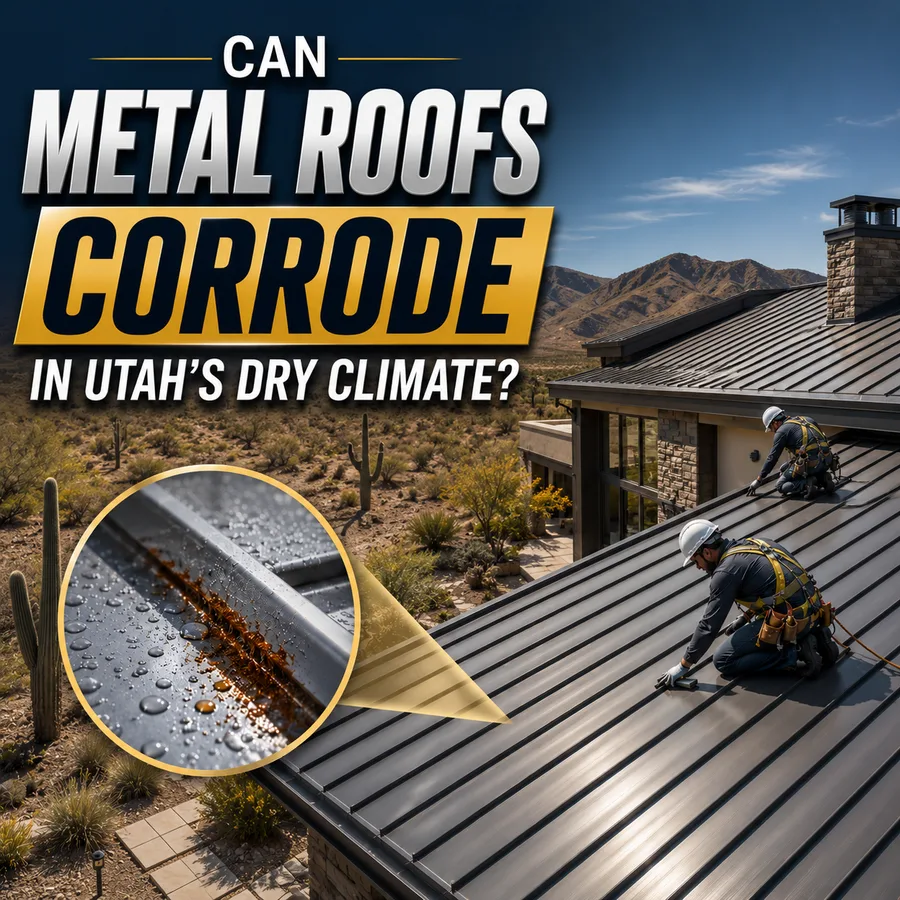
Quick answer: Metal roofs can corrode even in a dry climate when coatings are damaged, incompatible metals touch, moisture and salts collect, cut edges are exposed, or runoff concentrates contaminants. Correct material pairing and maintenance reduce risk.
A product label or roof age cannot settle this question by itself. Review the actual conditions and use metal roofing options as a starting point for relevant service options.
Key takeaways
- Metal roofs can corrode even in a dry climate when coatings are damaged, incompatible metals touch, moisture and salts collect, cut edges are exposed, or runoff concentrates contaminants. Correct material pairing and maintenance reduce risk.
- Utah roofs can receive dust, deicing salts, industrial fallout, and snowmelt. Dry periods do not prevent moisture from lingering beneath debris or at shaded details.
- Best next step: Follow the coating manufacturer’s cleaning and touch-up guidance.
What factors matter most?
Coating damage
Scratches, chips, and worn finishes can expose metal to moisture and oxygen. A useful scope states how this detail connects to drainage, attachment, flashing, or maintenance.
Dissimilar metals
Certain metal combinations can create galvanic corrosion when an electrolyte is present. Look for evidence on this roof rather than assuming the same condition exists across every slope or area.
Debris
Leaves, soil, and trapped moisture can hold contaminants against panels. Product instructions and the actual substrate help determine the appropriate response.
Runoff
Water from copper or treated materials may be incompatible with some metals or finishes. Evaluate it with the surrounding assembly because water and movement rarely stop at one component.
Fasteners and cuts
Accessories, swarf, and exposed edges need system-appropriate treatment. Its importance depends on location, adjacent details, exposure, and the condition of the rest of the roof.
How do Utah conditions change the answer?
Utah roofs can receive dust, deicing salts, industrial fallout, and snowmelt. Dry periods do not prevent moisture from lingering beneath debris or at shaded details.
Use weather history as context, then verify what is happening on the property. Roof geometry and surrounding terrain often explain why one area ages differently from another. Use product-specific requirements and local observations rather than a single statewide lifespan or performance promise.
What should you do next?
- Confirm compatible panels, flashings, fasteners, and accessories. Write the result down so later estimates and inspections can use the same facts.
- Remove metal shavings and construction debris promptly. The goal is to compare a complete scope instead of relying on a product name or a quick visual guess.
- Inspect scratches, cut edges, drainage traps, and mixed-metal contact. Where safety, structure, code, or electrical work is involved, use the appropriately qualified professional.
- Follow the coating manufacturer’s cleaning and touch-up guidance. Keep photos, product data, and written recommendations with the property records.
For service details and a site-based recommendation, review roof repair services. The next step should explain observed conditions, separate urgent work from maintenance, and result in a clear written recommendation.
What should a professional review?
- Panel profile, seams, and attachment
- Coating and cut-edge condition
- Edges, valleys, ridges, and penetrations
- Thermal-movement details
- Snow, drainage, and pedestrian consequences
A useful inspection connects exterior evidence with interior symptoms and the building’s history. It should also identify when another qualified professional is needed for structural, electrical, mechanical, design, policy, or legal questions.
What should you avoid?
Avoid using generic cleaners, wire brushes, or coatings that may damage the finish or void requirements.
Do not trade a roof question for a fall hazard. Document what can be seen safely and use qualified help for on-roof inspection.
Frequently asked questions
Does galvanized steel rust?
Protective zinc and coatings reduce corrosion, but damage, exposure, and time can still lead to deterioration.
Is aluminum better near salt?
Material selection depends on exposure and system design; compare documented corrosion performance.
What is galvanic corrosion?
It is accelerated corrosion that can occur between certain dissimilar metals in the presence of an electrolyte.
Can scratches be repaired?
Often, using manufacturer-approved methods appropriate to the coating and damage.
Why remove metal shavings?
Small steel particles can rust and stain or damage finished panels.
Get a clear roof recommendation
The right answer depends on the actual roof, not only its age or material. Learn about free roof inspection, or call All Star Roofing at (801) 381-0727 to schedule a free inspection or estimate. Coverage decisions remain with the insurance carrier, and project timing depends on weather, scope, materials, and scheduling.