

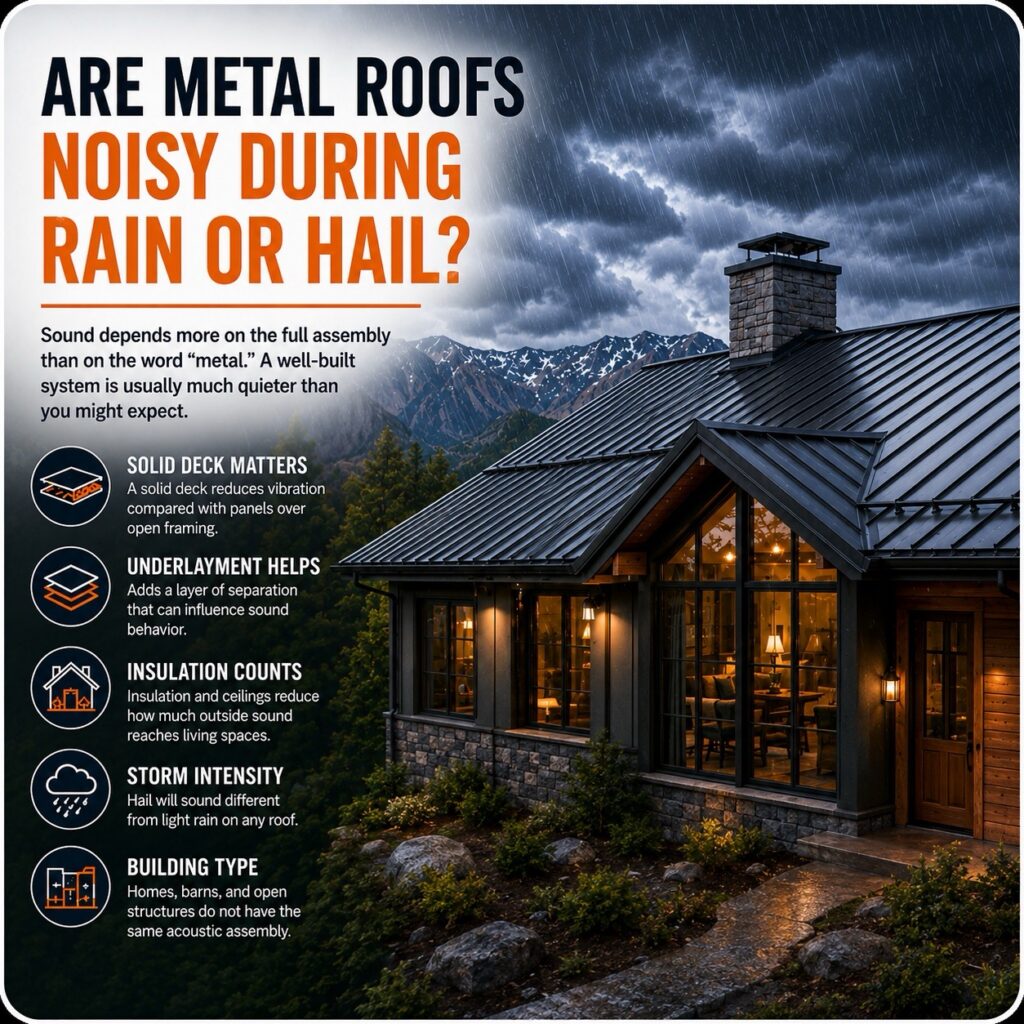
Quick answer: A metal roof over a solid deck with underlayment and an insulated building assembly is usually much quieter than an exposed metal panel on an open structure. Perceived sound depends more on the full assembly than on the word “metal.”
The decision should begin with the building and site, not a generic rule. Compare observed conditions with a complete written scope and review the company’s metal roofing options information.
Key takeaways
- A metal roof over a solid deck with underlayment and an insulated building assembly is usually much quieter than an exposed metal panel on an open structure. Perceived sound depends more on the full assembly than on the word “metal.”
- Utah’s occasional hail and intense thunderstorms make this a reasonable question, but a short sound clip or showroom panel is not a reliable predictor of a finished home.
- Best next step: Balance sound concerns with drainage, durability, appearance, and budget.
What factors matter most?
Roof deck
A solid deck changes vibration and sound transmission compared with panels spanning open framing. Evaluate it with the surrounding assembly because water and movement rarely stop at one component.
Underlayment
The layer beneath panels separates materials and can influence sound behavior. Its importance depends on location, adjacent details, exposure, and the condition of the rest of the roof.
Attic insulation
Insulation and interior ceilings affect how much exterior sound reaches occupied rooms. A useful scope states how this detail connects to drainage, attachment, flashing, or maintenance.
Storm intensity
Hail will sound different from light rain on any roof. Look for evidence on this roof rather than assuming the same condition exists across every slope or area.
Building type
A house, warehouse, patio cover, and barn do not have the same acoustic assembly. Product instructions and the actual substrate help determine the appropriate response.
How do Utah conditions change the answer?
Utah’s occasional hail and intense thunderstorms make this a reasonable question, but a short sound clip or showroom panel is not a reliable predictor of a finished home.
Conditions can change across short distances in Utah. Orientation, elevation, shade, terrain, and building use may change which detail deserves the most attention. Use product-specific requirements and local observations rather than a single statewide lifespan or performance promise.
What should you do next?
- Ask how the proposed panels will be supported. Write the result down so later estimates and inspections can use the same facts.
- Review the deck, underlayment, attic, and ceiling assembly. The goal is to compare a complete scope instead of relying on a product name or a quick visual guess.
- Visit a completed project with a comparable assembly if possible. Where safety, structure, code, or electrical work is involved, use the appropriately qualified professional.
- Balance sound concerns with drainage, durability, appearance, and budget. Keep photos, product data, and written recommendations with the property records.
For a property-specific next step, review residential roofing services. The next step should explain observed conditions, separate urgent work from maintenance, and result in a clear written recommendation.
What should a professional review?
- Panel profile, seams, and attachment
- Coating and cut-edge condition
- Edges, valleys, ridges, and penetrations
- Thermal-movement details
- Snow, drainage, and pedestrian consequences
A useful inspection connects exterior evidence with interior symptoms and the building’s history. It should also identify when another qualified professional is needed for structural, electrical, mechanical, design, policy, or legal questions.
What should you avoid?
Do not promise silence or compare a residential assembly to an exposed agricultural roof.
Keep roof access out of the homeowner or tenant checklist. Steep, wet, icy, storm-damaged, and unfamiliar surfaces require trained people and appropriate safety procedures.
Frequently asked questions
Is metal louder than asphalt?
It can sound different, but a complete residential assembly often moderates the difference substantially.
Does underlayment soundproof a roof?
No single layer soundproofs a roof; the deck, insulation, air space, and ceiling all contribute.
Will hail be audible?
Likely yes during a strong storm, though loudness depends on the assembly and hail intensity.
Can insulation help?
Insulation can reduce sound transmission while also serving its primary thermal role.
Should noise rule out metal?
Usually it is one factor among system design, cost, appearance, maintenance, and climate fit.
Get a clear roof recommendation
The right answer depends on the actual roof, not only its age or material. Learn about free roof inspection, or call All Star Roofing at (801) 381-0727 to schedule a free inspection or estimate. Coverage decisions remain with the insurance carrier, and project timing depends on weather, scope, materials, and scheduling.