

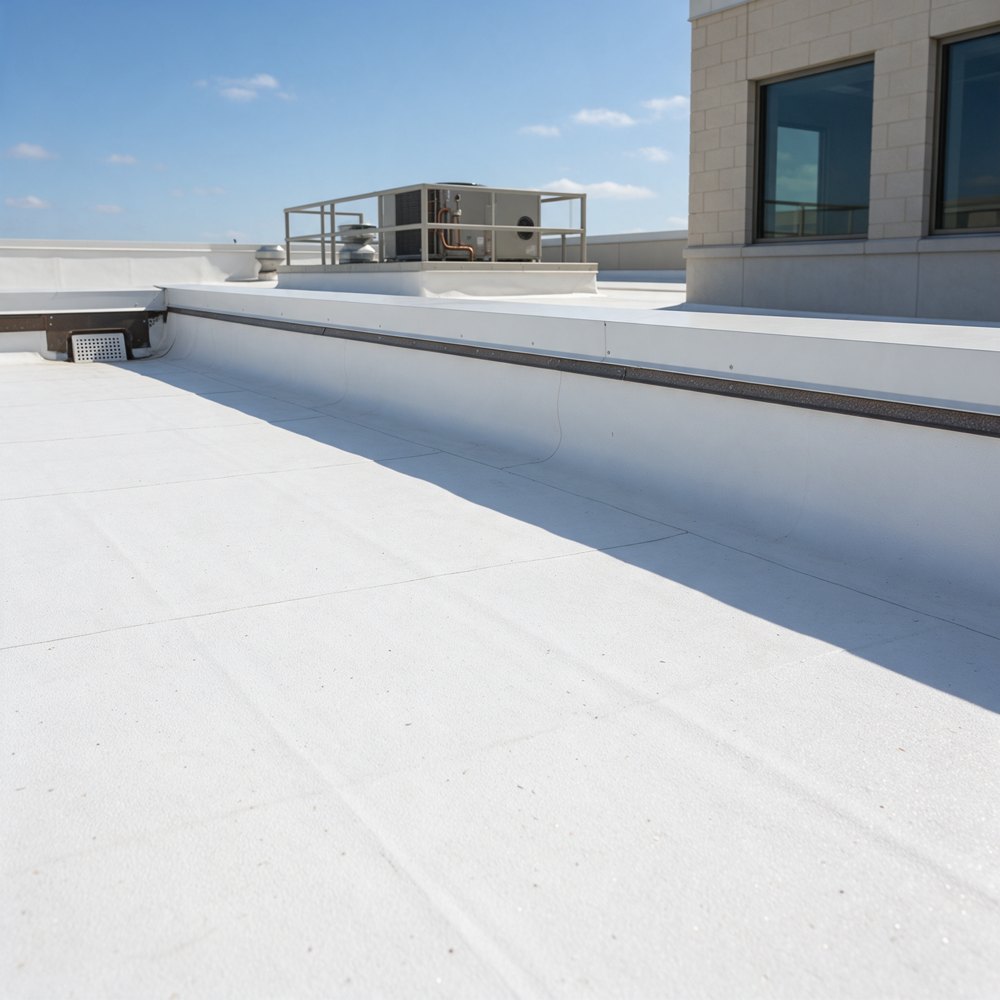
A 60-mil TPO membrane is a common middle option between 45-mil and 80-mil products, but thickness alone cannot identify the best roof for a Utah commercial building. The decision should also account for rooftop traffic, attachment, cover board, insulation, drainage, wind design, warranty requirements, and the condition of the existing assembly.
If two proposals offer “a new white TPO roof” at very different prices, the membrane may be only part of the difference. One contractor may include a cover board and a complete tear-off. Another may assume a recover over existing materials. One may include edge-metal replacement and new curb flashings while the other leaves those details vague. Comparing the millage without comparing that scope can lead you in the wrong direction.
First, what is a mil?
A mil is one-thousandth of an inch. A nominal 45-mil membrane is 0.045 inch thick, a 60-mil membrane is 0.060 inch, and an 80-mil membrane is 0.080 inch. These are thickness designations, not percentages, insulation values, or expected service lives.
All three can be reinforced single-ply TPO products. Their reinforcement, formulation, surface construction, backing, and approved installation methods still need to be checked in the specific manufacturer’s documentation. You cannot assume that an 80-mil sheet from one product family is equivalent in every respect to an 80-mil sheet from another.
The total sheet thickness is also different from the amount of material above the reinforcement. When evaluating durability claims, ask what the published specification actually measures. Product data sheets and the manufacturer’s proposed assembly should support the recommendation.
| Option | Why it enters the discussion | What still needs checking |
|---|---|---|
| 45-mil TPO | Potentially lower initial membrane cost | Whether the product and assembly meet project requirements and desired warranty |
| 60-mil TPO | An intermediate thickness to compare against other system improvements | Traffic protection, substrate, attachment, drainage, and warranty eligibility |
| 80-mil TPO | More membrane thickness for a project prioritizing durability | Whether the additional cost addresses the building’s actual risks |
What does a thicker membrane improve?
Within a comparable product family, a thicker membrane gives the roof more material. That can be useful when selecting a system for exposure and physical demands. It can also be part of the requirements for certain manufacturer warranty options. It does not make the roof immune to dropped tools, sharp debris, incompatible chemicals, or poor installation.
Consider a building with several rooftop HVAC units serviced regularly. The roof experiences traffic, equipment access, and occasional materials handling. More membrane thickness may deserve consideration, but designated access routes and compatible walkway protection are still important. A technician can damage a thick membrane by dragging a sharp component across it.
Now consider a smaller building with limited rooftop equipment and infrequent access. The best investment may include a suitable membrane plus stronger substrate protection, better drain details, or corrected attachment. The recommendation should explain why a particular thickness belongs in that complete system.
There is no reliable formula that converts the thickness increase into the same percentage increase in roof life. An 80-mil roof is not automatically entitled to a specific number of extra years. Actual performance depends on the installation, weather exposure, maintenance, and the roof’s other components.
Why the cover board can matter as much as the sheet
The membrane sits over other materials. Their condition and stiffness affect how the roof responds to foot traffic and localized loads. A suitable cover board can provide a more robust surface beneath the membrane and may contribute to the assembly’s fire, impact, or other performance, depending on the tested configuration.
That does not make every cover board suitable for every system. Type, thickness, fastening or adhesion, compatibility, and manufacturer approval matter. The roof design should identify the selected board rather than offering “cover board included” without a product or installation description.
Ask the contractor to price meaningful alternatives. For example, compare the specified membrane over the proposed substrate with an option that changes both membrane thickness and cover board. The useful question is which assembly better addresses your building’s needs, not which isolated component sounds most substantial.
If the existing roof contains wet or deteriorated materials, covering them with a thicker membrane does not resolve the underlying problem. Investigation of the existing assembly should precede a recover recommendation. The proposal needs a plan for unsuitable materials and a process for documenting additional removal.
For more on physical damage, read what causes punctures in TPO roofs. Membrane selection and access protection should work together.
Utah wind exposure is an assembly question
A commercial roof in Orem, Salt Lake City, or another Wasatch Front location needs to be designed for its building and exposure. Height, roof geometry, surrounding terrain, deck, and local design criteria influence wind demands. Roof edges and corners can require different treatment from the central field.
Thickness does not establish the attachment pattern. A membrane can be mechanically attached, fully adhered, or incorporated into another approved configuration. Each approach depends on the complete tested or approved assembly, including insulation attachment and perimeter details.
Ask who determines the required wind design and how it is translated into the proposal. On some projects, design professionals or additional testing are needed. Avoid substituting a generic fastener count or a marketing wind-speed number for the applicable building-specific requirements.
All Star Roofing’s TPO roofing service and commercial roof replacement information provide the service context. The final recommendation should identify the system, attachment approach, and details proposed for your property.
Drainage problems do not disappear with 80-mil TPO
Low-slope roofs need a working drainage plan. A thicker sheet does not add slope, lower a drain, or correct a blocked scupper. If the current roof holds water, ask whether the problem involves debris, insulation layout, settled areas, drain elevation, or another building condition.
Tapered insulation may be part of a solution, but it needs to fit the building, drainage layout, elevations, and applicable requirements. Adding material without coordinating curbs, doors, edges, and overflow drainage can introduce new problems.
Snow and freeze-thaw conditions also make accessible drainage and maintenance important. The roof needs details that manage water when conditions change; a membrane thickness upgrade should not be used to avoid that discussion. Drainage and structural loading are related considerations, but a roofing proposal should not make unsupported structural assurances.
If an estimate lists only square footage and membrane thickness, ask for the drainage scope before signing. It should be clear whether drains and scuppers will be inspected, repaired, replaced, or excluded and what happens when concealed conditions are discovered.
Read the warranty as a system document
Do not accept a universal statement such as “60-mil means a 20-year warranty” or “80-mil always gets 30 years.” Available terms vary by manufacturer, product, assembly, attachment, accessories, project conditions, and program requirements. The proposed project must qualify, and the actual issued warranty controls.
Manufacturer resources such as Carlisle’s warranty availability reference illustrate why the complete configuration matters. Ask which manufacturer program, if any, is included in your proposal and what your project must meet to qualify.
Request a sample of the specific warranty being offered. Find out whether it covers materials only or an eligible roof system, which labor costs are addressed, what exclusions apply, and whether inspections, maintenance, notifications, or fees are required. “NDL” and “system warranty” should be explained in the actual document, not left as reassuring abbreviations.
Separately, All Star Roofing offers a 10-year labor warranty. Ask for its written terms and how it relates to any manufacturer coverage in your bid. A contractor labor warranty and a manufacturer system warranty should not be presented as interchangeable promises.
What should the price comparison include?
The installed price of a TPO roof includes much more than the membrane roll. Access, tear-off, disposal, insulation, cover board, attachment, flashings, edge metal, penetrations, and drainage work can all affect the total. So can occupied-building logistics and the handling of unexpected deck conditions.
Instead of asking only, “How much more is 80-mil?” request the additional installed price for a clearly defined alternate. Keep the baseline scope the same. If the alternate requires different accessories or warranty provisions, have those changes identified rather than hidden in a single number.
A useful bid comparison includes:
- The exact membrane manufacturer, product, thickness, and backing if applicable.
- The existing assembly and whether the work is a tear-off or a proposed recover.
- Insulation type, thickness or specified performance, and tapered layout where needed.
- Cover board product and attachment.
- Membrane attachment, perimeter treatment, and penetration details.
- Drainage work, access protection, and maintenance expectations.
- The actual proposed warranty and exclusions.
- Allowances, unit prices, and approval procedures for concealed damage.
This level of detail helps an owner understand why a higher bid may include more necessary work. It also makes a lower bid easier to evaluate fairly. A price difference should trigger a scope comparison rather than an assumption that one contractor is charging too much or another is cutting corners.
When repair may be the better first step
If your current TPO roof is leaking, deciding on a replacement thickness may be premature. A leak can come from a localized flashing defect, a damaged seam, a puncture, an edge condition, or another cause. The condition of the membrane and underlying assembly determines whether repair is a practical option.
A professional assessment should look beyond the interior stain. It should consider the roof’s age, repair history, moisture concerns, attachment, and the condition of critical details. Some roofs can benefit from targeted commercial roof repairs and a maintenance plan; others need a replacement design.
Continue to control rooftop access in the meantime. Keep service records and communicate with HVAC contractors about walkways, dropped hardware, and repair reporting. These practices protect the investment regardless of the thickness eventually selected.
Choose the assembly that fits the building
For many owners, the most useful discussion begins with 60-mil as one comparison point, then tests whether a thinner or thicker specified system meets the project’s goals. The right choice is the one supported by the building assessment, product documentation, design requirements, and a clear installed scope.
More membrane can be valuable. It cannot compensate for unresolved wet materials, weak attachment, missing flashing work, or poor drainage. Before deciding, ask the contractor to explain the largest risks on your roof and show where the proposed budget addresses them.
To compare TPO options for a commercial property in All Star Roofing’s service territory, request an inspection and written estimate or call (801) 381-0727. A building-specific scope will tell you much more than a thickness label alone.