

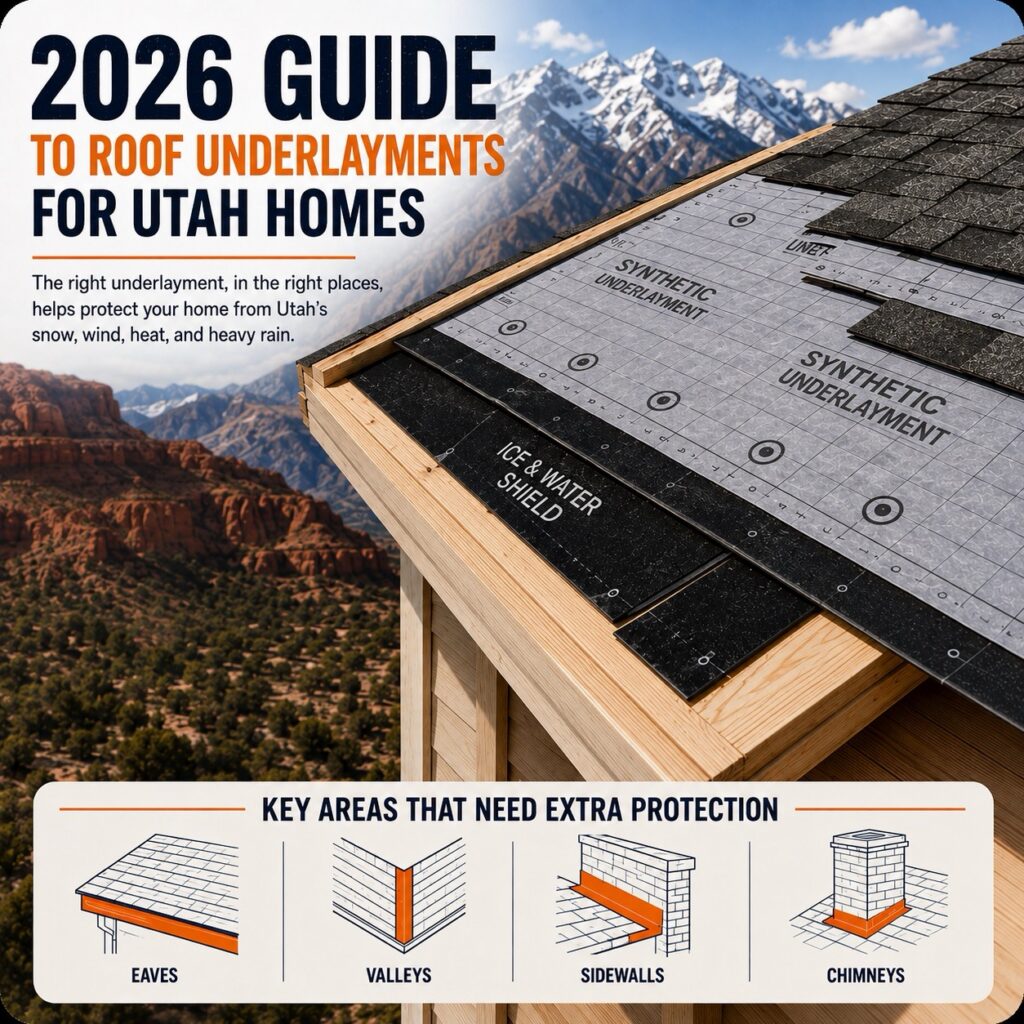
Quick answer: Roof underlayment is a secondary water-shedding layer beneath the finished covering. In Utah, the choice and placement should reflect roof slope, covering, valleys, eaves, penetrations, wind exposure, and ice-prone areas.
A product label or roof age cannot settle this question by itself. Review the actual conditions and use residential roofing services as a starting point for relevant service options.
Key takeaways
- Roof underlayment is a secondary water-shedding layer beneath the finished covering. In Utah, the choice and placement should reflect roof slope, covering, valleys, eaves, penetrations, wind exposure, and ice-prone areas.
- Snowmelt and wind-driven rain make transitions important, while hot roof surfaces can increase material temperatures. Product selection should follow the roof system and documented installation requirements.
- Best next step: Keep product documentation with the final roof records.
What factors matter most?
Synthetic underlayment
Common beneath steep-slope coverings because it is light, consistent, and available in products with different performance ratings. A useful scope states how this detail connects to drainage, attachment, flashing, or maintenance.
Self-adhered membrane
Often considered at vulnerable areas such as eaves, valleys, and penetrations, subject to the roof design and manufacturer instructions. Look for evidence on this roof rather than assuming the same condition exists across every slope or area.
Compatibility
The underlayment must be compatible with the roof covering, deck, fasteners, and expected temperatures. Product instructions and the actual substrate help determine the appropriate response.
Exposure limits
Underlayment is not a finished roof; permitted exposure time varies by product. Evaluate it with the surrounding assembly because water and movement rarely stop at one component.
Installation details
Wrinkles, poor laps, damaged areas, and incorrect fastening can undermine an otherwise good product. Its importance depends on location, adjacent details, exposure, and the condition of the rest of the roof.
How do Utah conditions change the answer?
Snowmelt and wind-driven rain make transitions important, while hot roof surfaces can increase material temperatures. Product selection should follow the roof system and documented installation requirements.
Use weather history as context, then verify what is happening on the property. Roof geometry and surrounding terrain often explain why one area ages differently from another. Use product-specific requirements and local observations rather than a single statewide lifespan or performance promise.
What should you do next?
- Ask the estimate to name the underlayment product or performance class. Write the result down so later estimates and inspections can use the same facts.
- Confirm where self-adhered protection is included. The goal is to compare a complete scope instead of relying on a product name or a quick visual guess.
- Review valleys, eaves, sidewalls, chimneys, vents, and low-slope transitions. Where safety, structure, code, or electrical work is involved, use the appropriately qualified professional.
- Keep product documentation with the final roof records. Keep photos, product data, and written recommendations with the property records.
For service details and a site-based recommendation, review roof replacement options. The next step should explain observed conditions, separate urgent work from maintenance, and result in a clear written recommendation.
What should a professional review?
- Roof covering and visible wear
- Flashings, valleys, edges, and penetrations
- Decking and interior moisture clues
- Ventilation and drainage
- Repair history and storm exposure
A useful inspection connects exterior evidence with interior symptoms and the building’s history. It should also identify when another qualified professional is needed for structural, electrical, mechanical, design, policy, or legal questions.
What should you avoid?
Do not describe underlayment as a substitute for sound shingles, panels, flashing, or drainage.
Do not trade a roof question for a fall hazard. Document what can be seen safely and use qualified help for on-roof inspection.
Frequently asked questions
Can underlayment stop every leak?
No. It is a secondary layer and cannot correct failed flashing, damaged covering, or poor drainage.
Is synthetic underlayment waterproof?
Products differ. Review the manufacturer’s classification and installation instructions rather than relying on a generic label.
Where is ice-and-water membrane used?
It is commonly considered at vulnerable locations, but the exact layout depends on design, code, product instructions, and project scope.
Can old underlayment stay during replacement?
That depends on the assembly and condition, but tear-off allows the deck and hidden conditions to be evaluated.
Should the estimate list underlayment?
Yes. A clear scope should identify the intended materials and locations.
Get a clear roof recommendation
The right answer depends on the actual roof, not only its age or material. Learn about free roof inspection, or call All Star Roofing at (801) 381-0727 to schedule a free inspection or estimate. Coverage decisions remain with the insurance carrier, and project timing depends on weather, scope, materials, and scheduling.