

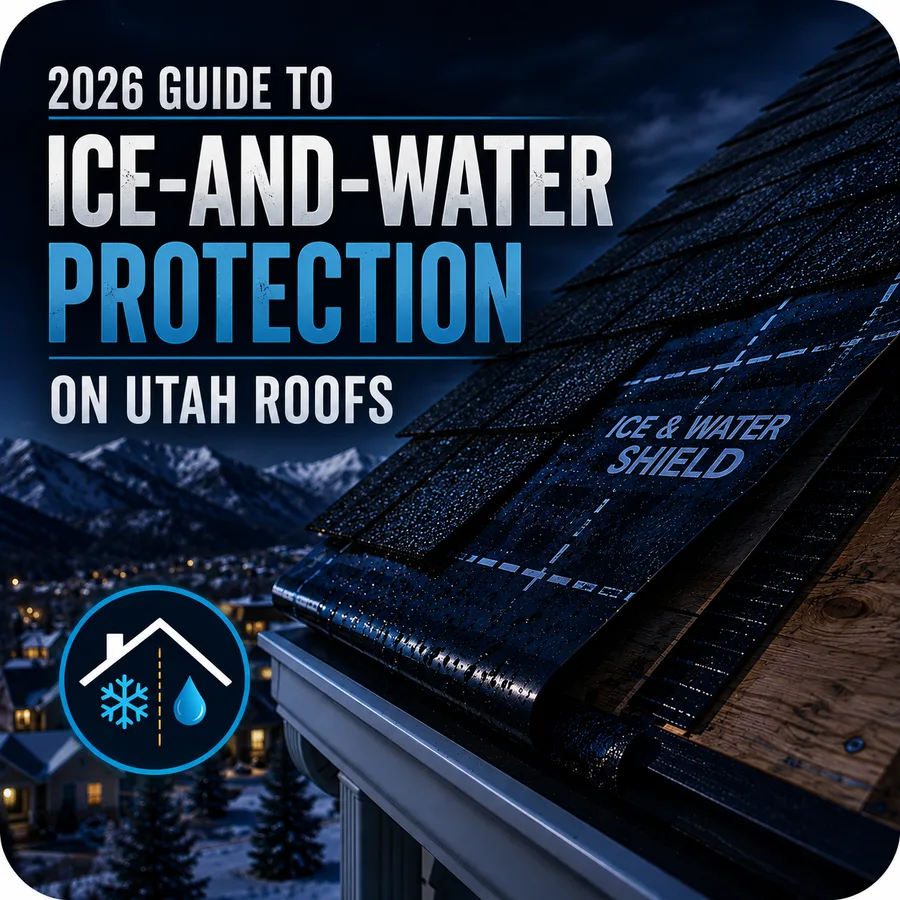
Quick answer: Ice-and-water protection is a self-adhered membrane used at selected vulnerable roof areas. It provides secondary protection against water intrusion but must be placed, lapped, and integrated for the specific roof, climate, code, and product.
The decision should begin with the building and site, not a generic rule. Compare observed conditions with a complete written scope and review the company’s roof replacement options information.
Key takeaways
- Ice-and-water protection is a self-adhered membrane used at selected vulnerable roof areas. It provides secondary protection against water intrusion but must be placed, lapped, and integrated for the specific roof, climate, code, and product.
- Utah mountain and valley sites have different ice exposure. Placement should not be copied from an unrelated climate or treated as a substitute for air sealing, insulation, ventilation, and drainage.
- Best next step: Keep product and installation records after completion.
What factors matter most?
Eaves
Cold-edge refreezing can push meltwater into vulnerable shingle laps. Evaluate it with the surrounding assembly because water and movement rarely stop at one component.
Valleys
Two roof planes concentrate runoff and snowmelt. Its importance depends on location, adjacent details, exposure, and the condition of the rest of the roof.
Penetrations
Chimneys, skylights, walls, and pipe penetrations interrupt the covering. A useful scope states how this detail connects to drainage, attachment, flashing, or maintenance.
Low-slope transitions
Slower drainage raises the importance of compatible layers and details. Look for evidence on this roof rather than assuming the same condition exists across every slope or area.
Deck and temperature
Adhesion requires a suitable, prepared substrate and installation conditions. Product instructions and the actual substrate help determine the appropriate response.
How do Utah conditions change the answer?
Utah mountain and valley sites have different ice exposure. Placement should not be copied from an unrelated climate or treated as a substitute for air sealing, insulation, ventilation, and drainage.
Conditions can change across short distances in Utah. Orientation, elevation, shade, terrain, and building use may change which detail deserves the most attention. Use product-specific requirements and local observations rather than a single statewide lifespan or performance promise.
What should you do next?
- Identify vulnerable zones on the roof plan. Write the result down so later estimates and inspections can use the same facts.
- Confirm compatible membrane and substrate preparation. The goal is to compare a complete scope instead of relying on a product name or a quick visual guess.
- Review transitions with underlayment, flashing, and covering. Where safety, structure, code, or electrical work is involved, use the appropriately qualified professional.
- Keep product and installation records after completion. Keep photos, product data, and written recommendations with the property records.
For a property-specific next step, review residential roofing services. The next step should explain observed conditions, separate urgent work from maintenance, and result in a clear written recommendation.
What should a professional review?
- Roof covering and visible wear
- Flashings, valleys, edges, and penetrations
- Decking and interior moisture clues
- Ventilation and drainage
- Repair history and storm exposure
A useful inspection connects exterior evidence with interior symptoms and the building’s history. It should also identify when another qualified professional is needed for structural, electrical, mechanical, design, policy, or legal questions.
What should you avoid?
Avoid saying the membrane makes a roof waterproof or guarantees prevention of ice-dam leaks.
Keep roof access out of the homeowner or tenant checklist. Steep, wet, icy, storm-damaged, and unfamiliar surfaces require trained people and appropriate safety procedures.
Frequently asked questions
Is it used over the whole roof?
Sometimes on specific assemblies, but commonly it is targeted to vulnerable areas; project requirements control.
Can it trap moisture?
Every assembly must manage interior and exterior moisture; compatibility and design matter.
Does it replace flashing?
No. Flashing still directs water at transitions and penetrations.
Can it be installed over old roofing?
The substrate and project scope must meet product and system requirements.
Why does attic work still matter?
Reducing heat loss and managing moisture addresses causes that membrane alone cannot remove.
Get a clear roof recommendation
The right answer depends on the actual roof, not only its age or material. Learn about free roof inspection, or call All Star Roofing at (801) 381-0727 to schedule a free inspection or estimate. Coverage decisions remain with the insurance carrier, and project timing depends on weather, scope, materials, and scheduling.