

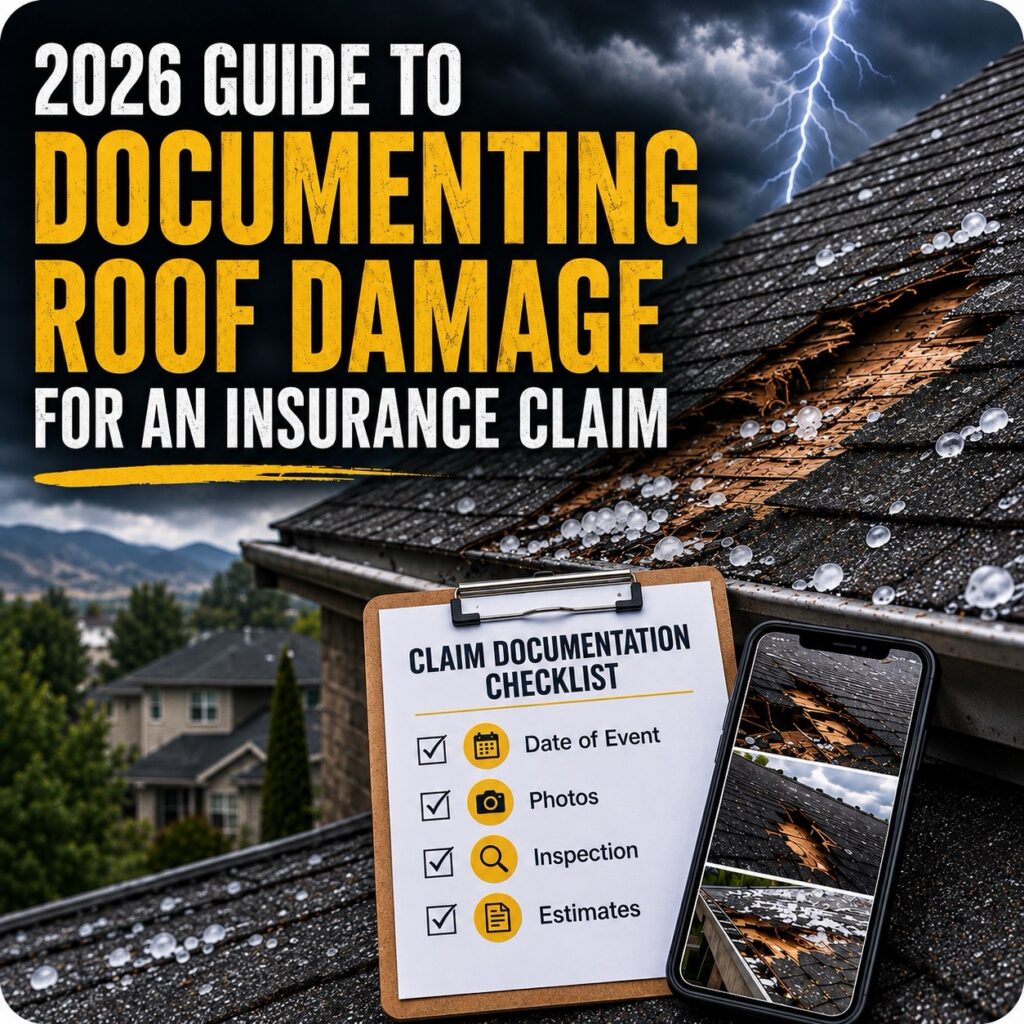
Quick answer: Good roof-claim documentation creates a dated, organized record of the event, visible damage, temporary protection, contractor findings, and communications. It supports the review but does not guarantee coverage or payment.
A product label or roof age cannot settle this question by itself. Review the actual conditions and use storm damage and insurance support as a starting point for relevant service options.
Key takeaways
- Good roof-claim documentation creates a dated, organized record of the event, visible damage, temporary protection, contractor findings, and communications. It supports the review but does not guarantee coverage or payment.
- The Utah Insurance Department advises consumers to review their policy and contact the insurer; coverage depends on the policy, cause of loss, roof condition, deductible, and carrier findings.
- Best next step: Compare the carrier scope with the contractor scope and ask about differences.
What factors matter most?
Event timeline
Record when the storm occurred and when each sign of damage was first noticed. A useful scope states how this detail connects to drainage, attachment, flashing, or maintenance.
Ground-level photos
Capture safe exterior and interior conditions without climbing onto the roof. Look for evidence on this roof rather than assuming the same condition exists across every slope or area.
Professional inspection
A roofer can document roof components, damage locations, and repair or replacement considerations. Product instructions and the actual substrate help determine the appropriate response.
Receipts and records
Keep invoices for reasonable emergency mitigation and prior roof work. Evaluate it with the surrounding assembly because water and movement rarely stop at one component.
Communication log
Save claim numbers, names, dates, emails, estimates, and carrier documents in one place. Its importance depends on location, adjacent details, exposure, and the condition of the rest of the roof.
How do Utah conditions change the answer?
The Utah Insurance Department advises consumers to review their policy and contact the insurer; coverage depends on the policy, cause of loss, roof condition, deductible, and carrier findings.
Use weather history as context, then verify what is happening on the property. Roof geometry and surrounding terrain often explain why one area ages differently from another. Use product-specific requirements and local observations rather than a single statewide lifespan or performance promise.
What should you do next?
- Protect people and the interior first. Write the result down so later estimates and inspections can use the same facts.
- Notify the insurer according to the policy and ask what documentation it needs. The goal is to compare a complete scope instead of relying on a product name or a quick visual guess.
- Schedule a roof inspection when conditions are safe. Where safety, structure, code, or electrical work is involved, use the appropriately qualified professional.
- Keep originals and submit organized copies. Keep photos, product data, and written recommendations with the property records.
- Compare the carrier scope with the contractor scope and ask about differences. Recheck the issue after the next significant weather event or project milestone.
For service details and a site-based recommendation, review free roof inspection. The next step should explain observed conditions, separate urgent work from maintenance, and result in a clear written recommendation.
What should a professional review?
- Cause and date of loss
- Roof condition and visible damage
- Photos, measurements, and contractor scope
- Policy and carrier correspondence
- Temporary protection and receipts
A useful inspection connects exterior evidence with interior symptoms and the building’s history. It should also identify when another qualified professional is needed for structural, electrical, mechanical, design, policy, or legal questions.
What should you avoid?
Do not stage damage, alter evidence unnecessarily, promise approval, or let a contractor speak as though it controls the carrier’s coverage decision.
Do not trade a roof question for a fall hazard. Document what can be seen safely and use qualified help for on-roof inspection.
Frequently asked questions
Should I climb onto the roof for photos?
No. Use safe ground-level documentation and a qualified inspection.
Does a roofer file the claim?
The policyholder generally communicates with the insurer; a roofer can provide roofing documentation and estimates.
Will photos guarantee approval?
No. They help document conditions, but the carrier applies the policy and its findings.
Should I keep temporary-repair receipts?
Yes. Keep clear records and ask the insurer about its mitigation procedures.
What if scopes differ?
Ask both parties to explain quantities, materials, damage areas, and omitted or disputed items in writing.
Get a clear roof recommendation
The right answer depends on the actual roof, not only its age or material. Learn about roof repair services, or call All Star Roofing at (801) 381-0727 to schedule a free inspection or estimate. Coverage decisions remain with the insurance carrier, and project timing depends on weather, scope, materials, and scheduling.